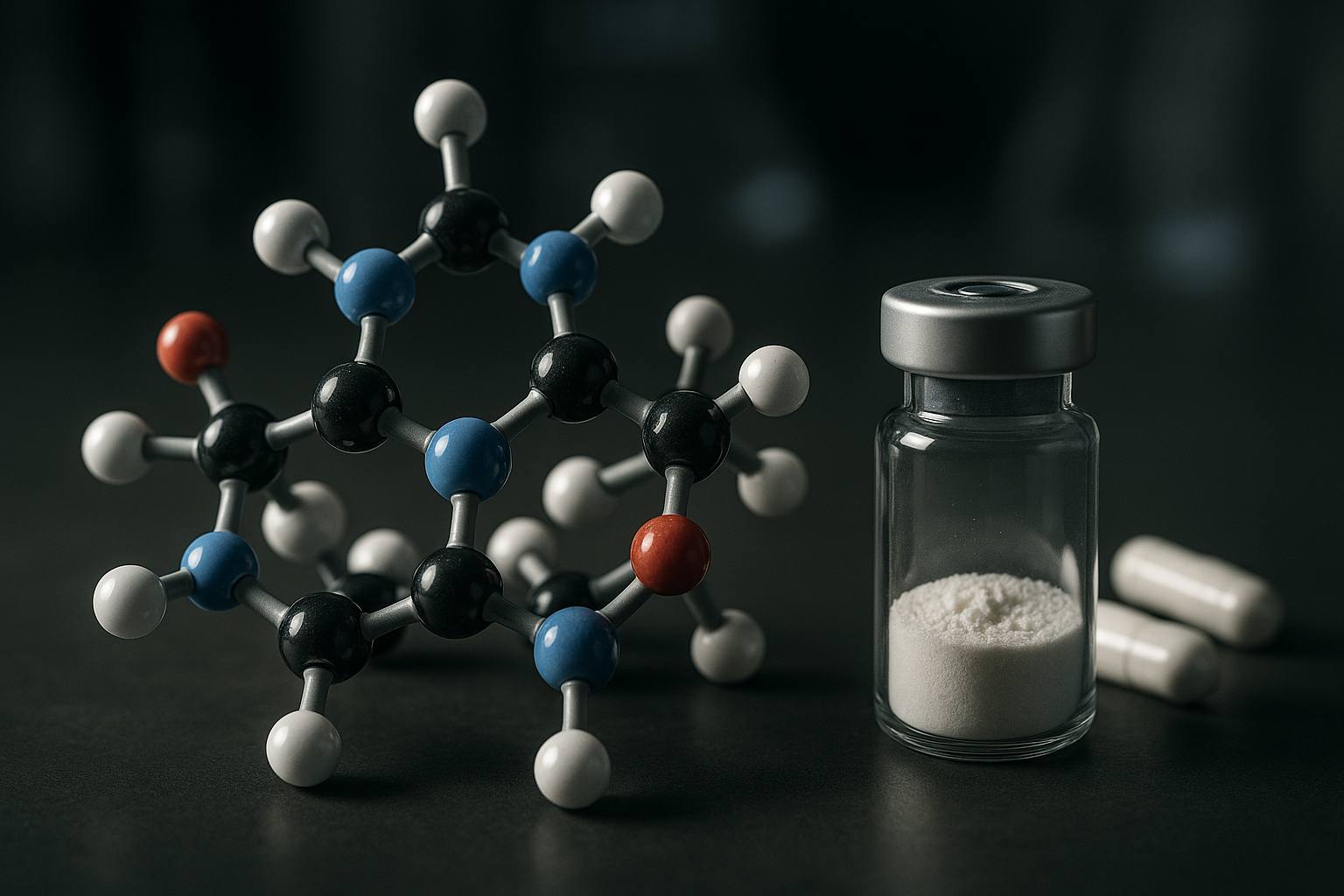
Hexarelin
Hexarelin is a synthetic peptide belonging to the Growth Hormone Secretagogues (GHS), studied for its ability to acutely stimulate the secretion of growth hormone (GH) and, in part, IGF-1 through activation of the ghrelin receptor (GHS-R1a). The literature is predominantly preclinical and clinical on small samples; use outside research carries risks and in many contexts is regulated or prohibited.
Growth hormone secretagogue peptide (GHS) with activity on ghrelin receptors (GHS-R1a)
Hexarelin is a synthetic peptide belonging to the Growth Hormone Secretagogues (GHS), studied for its ability to acutely stimulate the secretion of growth hormone (GH) and, in part, IGF-1 through activation of the ghrelin receptor (GHS-R1a). The literature is predominantly preclinical and clinical on small samples; use outside research carries risks and in many contexts is regulated or prohibited.
Mechanism of action
Agonist of the GHS-R1a receptor (ghrelin receptor) expressed at the hypothalamic and pituitary levels: it increases the release of GH (in a pulsatile manner) and may variably increase IGF-1 through the GH–IGF-1 axis. GHS-R1a activation may also influence appetite, glucose homeostasis, and the secretion of other hormones (e.g. prolactin and cortisol in some studies). It is distinct from GHRH analogues: GHS act through partially independent pathways and may show synergy with GHRH in experimental protocols.
Supported benefits
- Acute increase in GH secretion (dose-dependent response in controlled studies) (strong)
- Increase in IGF-1 in some protocols (variable; depends on dose, duration, and population) (moderate)
- Possible effects on body composition (lean/fat mass) in experimental settings, with inconclusive results and often confounded by water retention (limited)
- Possible cardiovascular effects (e.g. myocardial function) observed mainly in preclinical models and small clinical studies (emerging)
Safety & side effects
- Increased appetite
- Water retention, peripheral edema, possible rapid weight gain
- Paresthesias or carpal tunnel-like symptoms (if the GH/IGF-1 axis is significantly stimulated)
- Headache, flushing, dizziness (reported in some protocols)
- Possible alterations in blood glucose and insulin sensitivity (direction and magnitude vary; greater risk in those predisposed to metabolic disorders)
- Possible increase in prolactin and/or cortisol in some individuals
- Injection-site reactions (pain, redness, infection) if administered parenterally
FAQ
Is Hexarelin the same thing as GH?
No. Hexarelin is a secretagogue: it stimulates the endogenous release of GH through ghrelin receptors. GH is the hormone administered directly. The effects, pharmacokinetics, and risks may differ.
Does it really increase IGF-1?
In some studies IGF-1 increases, but the response is variable and depends on dose, duration, nutritional status, age, and individual sensitivity of the GH–IGF-1 axis.
Is it useful for increasing muscle mass and performance?
The acute increase in GH is well documented, but there is no solid and consistent evidence that this translates into significant performance improvements in healthy individuals. Part of the perceived changes may depend on water retention.
What are the main risks?
Water retention/edema, blood glucose alterations, possible changes in prolactin/cortisol, symptoms from excessive GH/IGF-1 signaling, and infectious/contamination risks linked to unregulated preparations.
Can it be detected in anti-doping testing?
GH secretagogues are prohibited in regulated sport. Detection methods and windows depend on the laboratory, biological matrix, and protocols; the risk of an anti-doping violation is real.
The information provided is for informational and educational purposes only. It does not constitute medical advice. Use must be evaluated and authorized by a qualified healthcare professional.
Mechanism of action
Agonist of the GHS-R1a receptor (ghrelin receptor) expressed at the hypothalamic and pituitary levels: increases GH release (pulsatile) and may variably increase IGF-1 through the GH–IGF-1 axis. GHS-R1a activation may also influence appetite, glucose homeostasis, and the secretion of other hormones (e.g. prolactin and cortisol in some studies). It is distinct from GHRH analogs: GHSs act on partially independent pathways and may show synergy with GHRH in experimental protocols.
Scientific benefits
Contraindications
- Pregnancy and breastfeeding (lack of adequate safety data)
- Pediatric age outside controlled clinical protocols
- Active or suspected neoplasms, or a history of GH/IGF-1-sensitive tumors (potential theoretical risk of promoting tumor growth through the IGF-1 axis)
- Uncontrolled diabetes or severe insulin resistance (risk of worsening glycemic control)
- Unstable endocrine disorders (e.g. acromegaly, unevaluated pituitary disorders)
- Significant edema, uncontrolled heart failure (risk of water retention)
Side effects
- Increased appetite
- Water retention, peripheral edema, possible rapid weight gain
- Paresthesias or carpal tunnel-like symptoms (if the GH/IGF-1 axis is significantly stimulated)
- Headache, flushing, dizziness (reported in some protocols)
- Possible alterations in blood glucose and insulin sensitivity (variable direction and magnitude; greater risk in those predisposed to metabolic disorders)
- Possible increase in prolactin and/or cortisol in some individuals
- Injection site reactions (pain, redness, infection) if administered parenterally
Interactions
- Glucose-lowering drugs/insulin: possible need for clinical adjustments (risk of hyper/hypoglycemia) in case of changes in insulin sensitivity
- Glucocorticoids: may antagonize some anabolic/metabolic effects of the GH axis and influence the endocrine response
- Hormonal therapies (e.g. exogenous GH, IGF-1, androgens, estrogens): potential additive effects and increased risk of adverse events
- Drugs affecting the hypothalamic-pituitary axis (dopaminergics, antipsychotics that increase prolactin): possible interactions involving prolactin and other hormones
Regulatory status
In many jurisdictions it is not approved as a medicine; it is often improperly sold as a “research chemical”. In the anti-doping context it is generally considered prohibited as a GH secretagogue (category S2 or equivalent in WADA lists, depending on the annual update).
Supplements and peptides
 Peptides
Bpc-157
BPC-157 is a 15-amino-acid peptide derived from a sequence present in gastric juice (BPC). It is the subject of…
 Peptides
Cjc-1295
CJC-1295 is a peptide designed to stimulate the pulsatile secretion of growth hormone (GH) through activation of the…
 Peptides
Dsip
DSIP (Delta Sleep-Inducing Peptide) is a peptide originally described for its possible ability to modulate sleep…