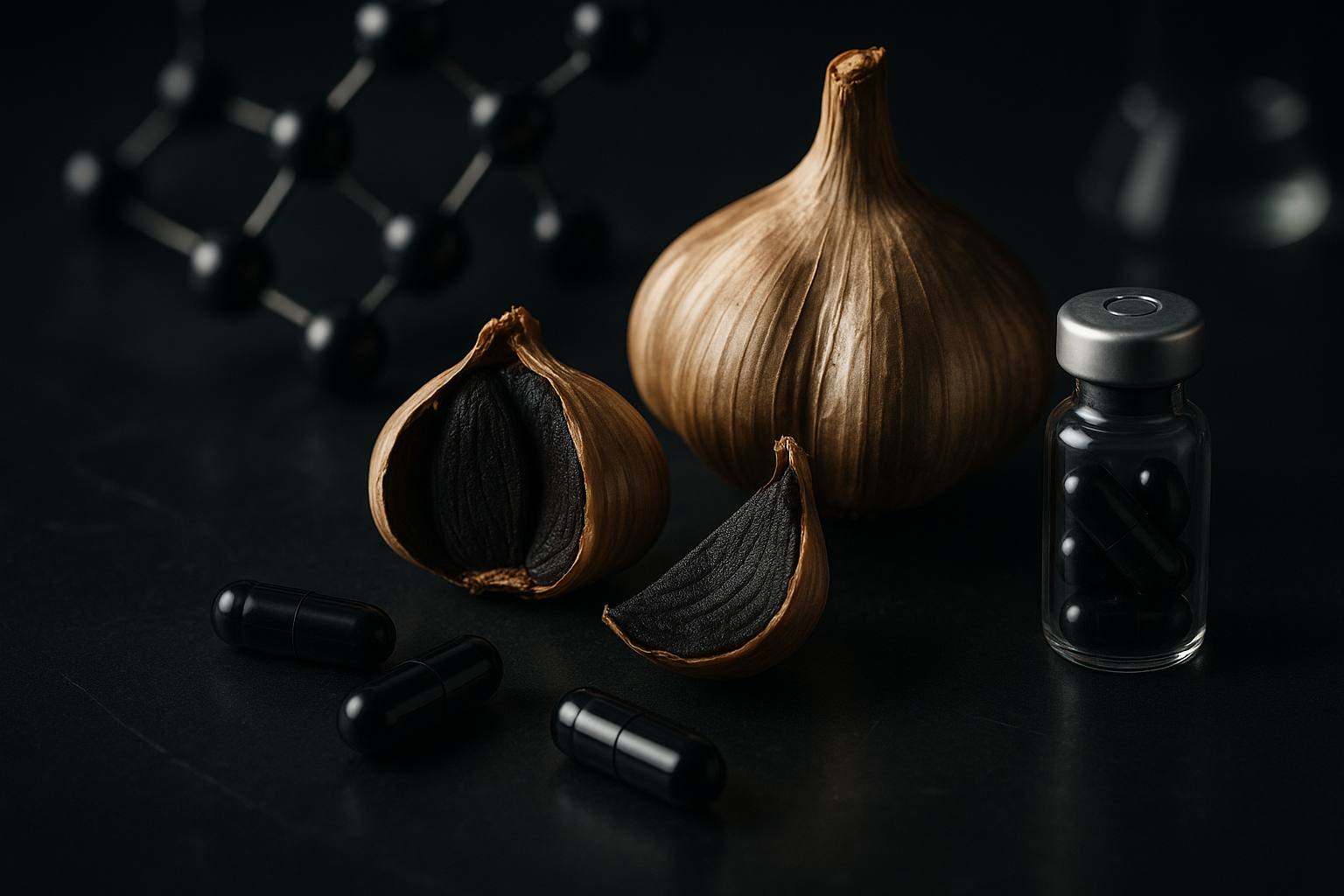
Black garlic
Black garlic is obtained through the controlled aging of garlic (Allium sativum) under conditions of high temperature and humidity for weeks. This process profoundly alters the chemical profile: irritating compounds typical of fresh garlic decrease, while water-soluble and antioxidant molecules (e.g. S-allyl-cysteine) increase, with possible effects on oxidative stress, endothelial function, and cardiometabolic parameters that may indirectly influence mental energy and cognitive performance.
Fermented/heat-treated phytocompound with potential neurovascular and antioxidant support (Focus & Nootropics)
Black garlic is obtained through the controlled aging of garlic (Allium sativum) under conditions of high temperature and humidity for weeks. This process profoundly alters the chemical profile: irritating compounds typical of fresh garlic decrease, while water-soluble and antioxidant molecules (e.g. S-allyl-cysteine) increase, with possible effects on oxidative stress, endothelial function, and cardiometabolic parameters that may indirectly influence mental energy and cognitive performance.
Mechanism of action
Proposed mechanisms (depending on composition and dose): - Antioxidant action: increased radical scavenging capacity and modulation of endogenous systems (e.g. the Nrf2 pathway/antioxidant enzymes) observed in preclinical models. - Inflammatory modulation: reduction of pro-inflammatory mediators (e.g. NF-κB and cytokines) reported mainly in in vitro/animal studies. - Endothelial and vascular support: possible increase in nitric oxide (NO) bioavailability and improvement in endothelial function; potential impact on blood pressure and vascular stiffness in some clinical studies. - Effects on lipid and glucose metabolism: possible improvements in lipid profiles and insulin sensitivity in selected populations; mechanisms include modulation of hepatic enzymes and oxidative stress. - Neuroprotection (preclinical): effects on neuronal oxidative stress, neuroinflammation, and synaptic plasticity have been described in animal models; clinical translation remains to be confirmed.
Supported benefits
- Improvement in some cardiometabolic markers (e.g. blood pressure, lipid profile) in specific populations and with standardized extracts (moderate)
- Increase in antioxidant capacity and reduction in oxidative stress markers (more consistent in preclinical studies; variable in clinical settings) (moderate)
- Support for endothelial/vascular function (potential indirect benefit on cerebral perfusion) (limited)
- Direct cognitive benefits (attention, memory, processing speed) in humans (emerging)
Safety & side effects
- Gastrointestinal disturbances (nausea, dyspepsia, bloating, diarrhea), generally dose-dependent
- Bad breath/body odor generally reduced compared with fresh garlic but still possible
- Headache or dizziness in sensitive individuals (uncommon; possible relation to blood pressure changes)
- Allergic reactions (rare) in individuals sensitive to Allium
FAQ
Is black garlic a “direct” nootropic for attention and memory?
Direct clinical evidence for attention/memory is still emerging. Interest is mainly indirect: improvement in vascular function, oxidative stress, and cardiometabolic parameters may support brain health, but this does not equate to an acute and guaranteed nootropic effect.
Is it different from fresh garlic in terms of active compounds?
Yes. Aging generally increases water-soluble compounds such as S-allyl-cysteine and alters the profile of organosulfur compounds and polyphenols, often with greater antioxidant capacity and better olfactory/gastrointestinal tolerability than fresh garlic.
Does extract standardization matter?
Yes. Studies use products with different compositions; standardization (e.g. SAC) helps make dose and effects more comparable. Without standardization, variability among products can be high.
Can it affect blood pressure or coagulation?
It may affect vascular parameters and potentially platelet aggregation; for this reason it is relevant for those taking anticoagulants/antiplatelet agents or who have a bleeding risk, and for those on antihypertensive therapy.
The information provided is for informational and educational purposes only. It does not constitute medical advice. Use should be evaluated and authorized by a qualified healthcare professional.
Mechanism of action
Proposed mechanisms (depending on composition and dose): - Antioxidant action: increased free radical scavenging capacity and modulation of endogenous systems (e.g. via Nrf2/antioxidant enzymes) observed in preclinical models. - Inflammatory modulation: reduction of pro-inflammatory mediators (e.g. NF-κB and cytokines) reported mainly in in vitro/animal studies. - Endothelial and vascular support: possible increase in nitric oxide (NO) bioavailability and improvement in endothelial function; potential impact on blood pressure and vascular stiffness in some clinical studies. - Effects on lipid and glucose metabolism: possible improvements in lipid profiles and insulin sensitivity in selected populations; mechanisms include modulation of hepatic enzymes and oxidative stress. - Neuroprotection (preclinical): effects on neuronal oxidative stress, neuroinflammation, and synaptic plasticity have been described in animal models; clinical translation remains to be confirmed.
Scientific benefits
Contraindications
- Allergy or hypersensitivity to garlic/Allium
- Bleeding disorders or a history of significant bleeding (clinical evaluation required)
- Scheduled surgery: it is often considered prudent to discontinue supplements with potential antiplatelet effects before procedures (medical decision)
- Pregnancy and breastfeeding: insufficient specific clinical data on concentrated extracts; caution advised
- Peptic ulcer or active gastritis: possible worsening of symptoms in some individuals
Side effects
- Gastrointestinal disturbances (nausea, dyspepsia, bloating, diarrhea), generally dose-dependent
- Bad breath/body odor generally reduced compared with fresh garlic but still possible
- Headache or dizziness in sensitive individuals (uncommon; possible relation to blood pressure changes)
- Allergic reactions (rare) in individuals sensitive to Allium
Interactions
- Anticoagulants/antiplatelet agents (e.g. warfarin, DOACs, aspirin, clopidogrel): possible increased risk of bleeding; clinical monitoring required
- Antihypertensive drugs: possible additive effect on blood pressure in some individuals
- Glucose-lowering drugs/insulin: possible additive effect on glycemic control (risk of hypoglycemia in predisposed individuals)
- Saquinavir and some drugs metabolized by CYP/P-gp: garlic (especially in some forms) is known for possible interactions; for black garlic the data are less robust, but caution is reasonable
Regulatory status
Generally sold as a food or supplement. It is not approved as a drug for nootropic indications. Any health claims depend on local authorities and the specific formulation.
Supplements and peptides
 Focus & Nootropics
Agmatine sulfate
Agmatine is an endogenous metabolite produced by decarboxylation of L-arginine. In supplementation contexts it is…
 Focus & Nootropics
Alpha-gpc
Alpha-GPC is a choline-containing compound (a precursor of acetylcholine) and an intermediate in phospholipid…
 Focus & Nootropics
Anhydrous caffeine
Anhydrous caffeine is the dehydrated form of caffeine, used in supplements for its high concentration and dosing…