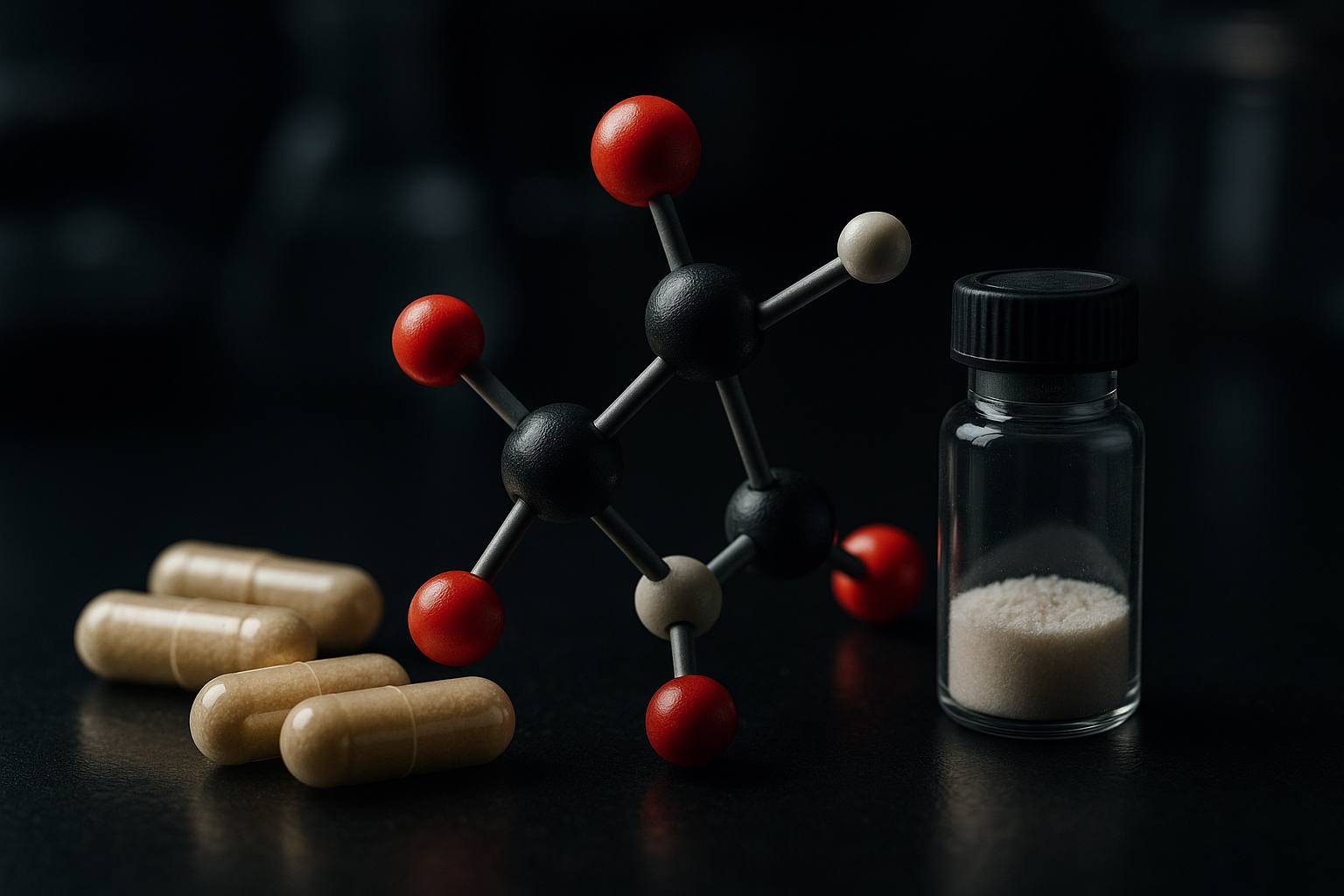
Carnitine fumarate
Carnitine fumarate is a salt form of L-carnitine in which carnitine is associated with fumarate (an intermediate of the Krebs cycle). L-carnitine is involved in the transport of long-chain fatty acids into the mitochondria for β-oxidation. In the “performance” field, the effects observed in studies are heterogeneous and often depend on nutritional status, training level, duration of intake, and the ability to increase muscle carnitine stores.
An L-carnitine salt with fumaric acid: support for fatty acid transport and energy metabolism, with mixed evidence regarding performance
Carnitine fumarate is a salt form of L-carnitine in which carnitine is associated with fumarate (an intermediate of the Krebs cycle). L-carnitine is involved in transporting long-chain fatty acids into the mitochondria for β-oxidation. In the “performance” context, the effects observed in studies are heterogeneous and often depend on nutritional status, training level, duration of use, and the ability to increase muscle carnitine stores.
Mechanism of action
1) Mitochondrial transport of fatty acids: L-carnitine facilitates the entry of long-chain fatty acids into the mitochondria via the CPT1/CPT2 system and translocase, promoting β-oxidation when lipid substrate is available. 2) Metabolic buffering: carnitine can bind acyl groups (acylcarnitines), helping maintain the free CoA/acyl-CoA ratio and potentially supporting metabolic flexibility. 3) Indirect effects on recovery and muscle damage: some studies suggest reductions in markers of damage/inflammation and DOMS, with proposed mechanisms including improved perfusion and reduced oxidative stress, but results are not uniform. 4) Microbiota and TMAO: some carnitine may be converted into trimethylamine (TMA) by the microbiota and then into TMAO in the liver; the clinical significance of TMAO is debated and may depend on dietary context, kidney function, and individual risk profile.
Supported benefits
- Reduction in muscle soreness (DOMS) and some markers of muscle damage in specific protocols (moderate)
- Possible improvement in work capacity/exercise efficiency in subgroups or with prolonged protocols aimed at increasing muscle carnitine (limited)
- Support in conditions of carnitine deficiency (e.g. certain clinical or nutritional conditions) with improvement in energy-related parameters (strong)
- Reduction in perceived fatigue in some studies, with high interindividual variability (emerging)
Safety & side effects
- Gastrointestinal disturbances (nausea, cramps, diarrhea), more likely at high doses or in sensitive individuals
- “Fishy” body odor (from metabolites such as TMA) in some individuals
- Headache or restlessness occasionally reported
- Increased TMAO in some studies (clinical significance not unequivocal, but relevant in the context of cardiometabolic risk and kidney function)
FAQ
Is carnitine fumarate different from L-carnitine tartrate or acetyl-L-carnitine?
The main difference is the chemical form and therefore the percentage of elemental L-carnitine and certain pharmacokinetic/tolerability properties. Much of the evidence on performance and recovery comes from L-carnitine (often tartrate) or acetyl-L-carnitine; transferability to the fumarate form depends on the equivalent L-carnitine dose and the study context.
Does it definitely increase “fat burning” during exercise?
Not necessarily. Although carnitine is essential for transporting fatty acids into the mitochondria, in individuals with adequate status oral intake often does not significantly increase intramuscular carnitine, which is the limiting factor for a marked effect on β-oxidation during exercise.
Why do some studies use carbohydrates together with carnitine?
Because insulin may promote carnitine uptake/retention in muscle in some experimental protocols. However, this strategy may not be appropriate for everyone (e.g. glycemic management, dietary goals) and does not guarantee performance results.
Is the TMAO issue a certain risk?
Carnitine intake may increase TMAO in some individuals, but the clinical significance is complex and depends on overall diet, microbiota, kidney function, and cardiometabolic risk profile. There is no single consensus that increased TMAO from carnitine automatically implies harm, but it is a point of caution especially in at-risk individuals.
Is it useful if I follow a vegetarian/vegan diet?
Dietary carnitine intake is generally lower in diets without animal-derived foods, but the body can synthesize it endogenously. The usefulness of supplementation depends on individual status, nutritional cofactors, and the context (training, symptoms, clinical conditions), and should be assessed professionally.
The information provided is for informational and educational purposes only. It does not constitute medical advice. Use must be evaluated and authorized by a qualified healthcare professional.
Mechanism of action
1) Mitochondrial transport of fatty acids: L-carnitine facilitates the entry of long-chain fatty acids into the mitochondria via the CPT1/CPT2 system and the translocase, promoting β-oxidation when lipid substrate is available. 2) Metabolic buffering: carnitine can bind acyl groups (acylcarnitines), helping maintain the free CoA/acyl-CoA ratio and potentially supporting metabolic flexibility. 3) Indirect effects on recovery and muscle damage: some studies suggest reductions in markers of damage/inflammation and DOMS, with proposed mechanisms including improved perfusion and reduced oxidative stress, but results are not consistent. 4) Microbiota and TMAO: part of carnitine may be converted to trimethylamine (TMA) by the microbiota and then to TMAO in the liver; the clinical significance of TMAO is debated and may depend on dietary context, kidney function, and individual risk profile.
Scientific benefits
Contraindications
- History of seizures/epilepsy: some reports suggest caution with carnitine in predisposed individuals (professional evaluation required)
- Pregnancy and breastfeeding: insufficient data for use not clinically indicated
- Kidney disorders: possible altered elimination and greater relevance of TMAO; professional evaluation required
- Thyroid disorders: carnitine may interfere with the action of thyroid hormones at the peripheral level in some contexts (caution and supervision)
Side effects
- Gastrointestinal disturbances (nausea, cramps, diarrhea), more likely at high doses or in sensitive individuals
- “Fishy” body odor (from metabolites such as TMA) in some individuals
- Headache or restlessness occasionally reported
- Increase in TMAO in some studies (clinical significance not unequivocal, but relevant in the context of cardiometabolic risk and kidney function)
Interactions
- Thyroid hormones (e.g. levothyroxine): possible peripheral functional antagonism by carnitine; clinical relevance depends on the case
- Coumarin anticoagulants (e.g. warfarin): reports of possible INR changes with L-carnitine in some cases; requires clinical monitoring if taken together
- Drugs that affect carnitine metabolism/transport (e.g. valproate may reduce carnitine): interaction mainly relevant in clinical settings
Regulatory status
Generally marketed as a dietary supplement. It does not typically appear to be included among prohibited substances as an active ingredient; however, sports regulations may consider methods of administration relevant (e.g. intravenous infusions), and anti-doping rules should be verified in the specific context.
Supplements and peptides
 Performance
Acetyl l-carnitine
Acetyl-L-carnitine (ALCAR) is a form of carnitine in which an acetyl group facilitates entry into tissues and the…
 Performance
Anhydrous betaine (trimethylglycine)
Anhydrous betaine (TMG) is a compound naturally present in various foods (e.g. beetroot, spinach, cereals) and also…
 Performance
Arginine akg
Arginine AKG (AAKG) combines L-arginine with α-ketoglutarate (AKG), an intermediate in the Krebs cycle. It is marketed…