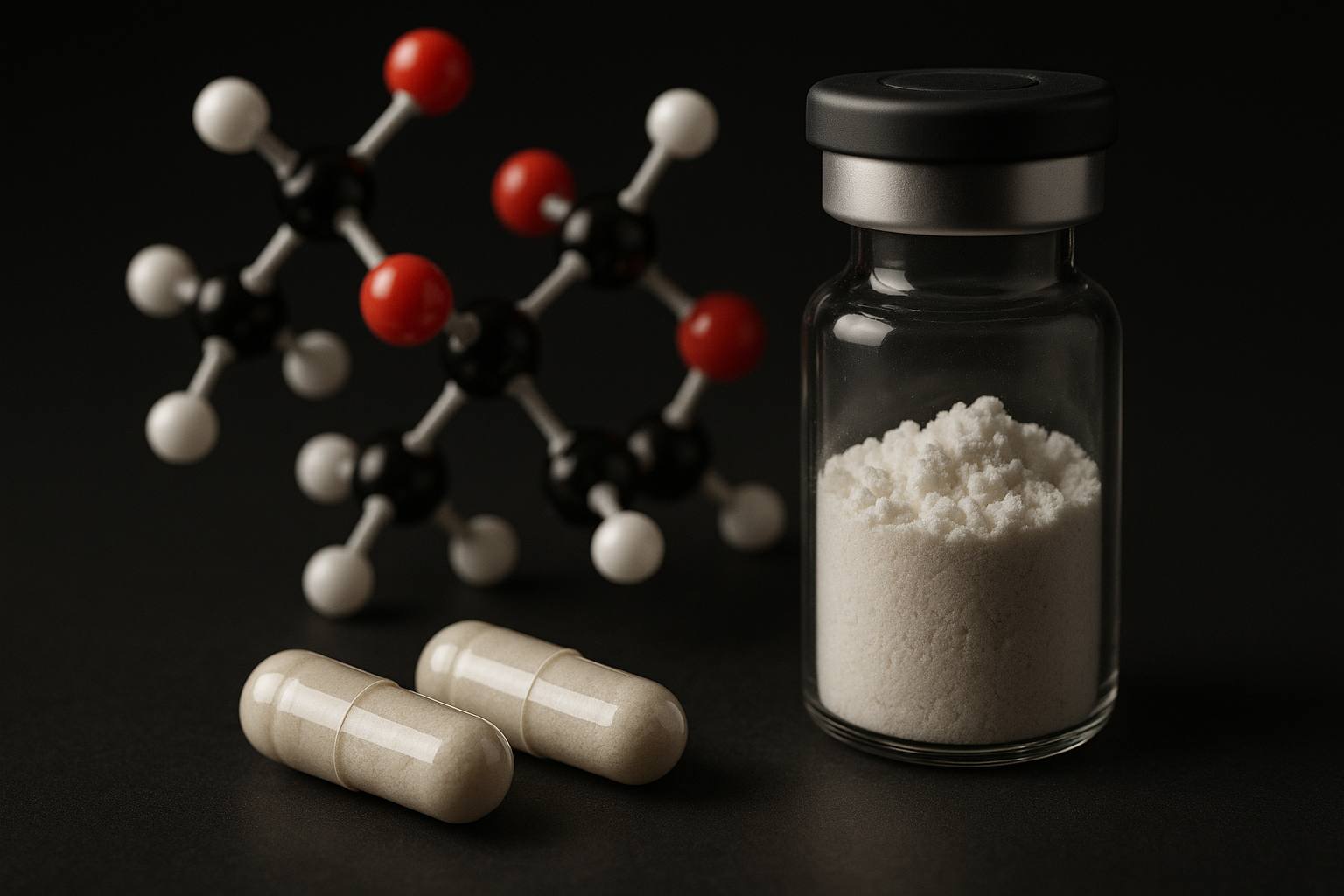
Choline bitartrate
Choline bitartrate is a salt of choline (an essential nutrient) used as a supplement to increase choline intake, a molecule involved in the synthesis of acetylcholine, phosphatidylcholine, and betaine. It is used in the “focus/nootropics” field mainly as indirect support for cholinergic function, but the evidence for cognitive improvements in healthy individuals is generally limited and depends on nutritional status, dose, and the form of choline.
A choline precursor for cholinergic support and phospholipid metabolism (Focus & Nootropics)
Choline bitartrate is a salt of choline (an essential nutrient) used as a supplement to increase choline intake, a molecule involved in the synthesis of acetylcholine, phosphatidylcholine, and betaine. It is used in the “focus/nootropics” field primarily as indirect support for cholinergic function, but the evidence for cognitive improvements in healthy individuals is generally limited and depends on nutritional status, dose, and the form of choline.
Mechanism of action
After absorption, choline enters the systemic pool and is: (a) taken up by cholinergic neurons for the synthesis of acetylcholine via choline acetyltransferase (choline availability may become limiting under some conditions); (b) used in the liver and other tissues for the synthesis of phosphatidylcholine via the CDP-choline pathway (Kennedy pathway) or via PEMT; (c) oxidized to betaine, which donates a methyl group to homocysteine via BHMT, contributing to homocysteine control and methyl metabolism. A portion of dietary/supplemental choline may be metabolized by the microbiota into trimethylamine (TMA), then oxidized in the liver to TMAO; the clinical impact of TMAO depends on the context (diet, kidney function, cardiometabolic risk) and remains under investigation.
Supported benefits
- Correction/supplementation of choline intake in cases of insufficient dietary intake (support for choline-dependent physiological functions) (strong)
- Support for liver function related to lipid export (prevention of choline deficiency-induced steatosis in controlled settings) (moderate)
- Reduction of homocysteine through increased betaine (biochemical effect; variable clinical relevance) (moderate)
- Improvement in attention/memory in healthy, well-nourished individuals (as a “stand-alone” nootropic) (limited)
- Cognitive support in conditions involving cholinergic deficit or in specific populations (heterogeneous evidence; often studied with other forms of choline) (emerging)
Safety & side effects
- Gastrointestinal disturbances (nausea, cramps, diarrhea), more likely at high doses
- “Fishy” body odor (from TMA), in predisposed individuals or at high doses
- Increased sweating, salivation, headache (possible signs of cholinergic excess in sensitive individuals)
- Hypotension or dizziness in some cases (reported with cholinergic excess; uncommon at nutritional doses)
- Increase in TMAO (an associative marker in observational studies; individual clinical significance is not deterministic)
FAQ
Does choline bitartrate cross the blood-brain barrier better than other forms?
It increases systemic choline, but it is not considered the most “brain-targeted” form. Forms such as citicoline or alpha-GPC are often chosen when the goal is to maximize the increase in choline available to the CNS, although clinical efficacy depends on the context and is not guaranteed.
Can it improve memory and concentration in healthy people?
Evidence in healthy individuals is generally limited: if dietary choline intake is already adequate, additional supplementation may not translate into measurable cognitive benefits. Results vary by dose, duration, cognitive tests, and individual characteristics.
Why can a “fishy” odor appear?
A portion of choline may be converted by the microbiota into trimethylamine (TMA), which has a characteristic odor. In conditions such as trimethylaminuria or at high doses, the odor may become noticeable.
Is it better to take it with or without food?
Taking it with food often improves gastrointestinal tolerability. There is no universally superior timing for acute cognitive effects.
What is the difference between choline and betaine?
Choline is a nutrient used for acetylcholine and phospholipids; it can be oxidized to betaine. Betaine acts mainly as a methyl donor (homocysteine) and osmoprotectant, whereas choline also has structural and neurochemical roles.
The information provided is for informational and educational purposes only. It does not constitute medical advice. Use should be evaluated and authorized by a qualified healthcare professional.
Mechanism of action
After absorption, choline enters the systemic pool and is: (a) taken up by cholinergic neurons for the synthesis of acetylcholine via choline acetyltransferase (choline availability can become limiting under some conditions); (b) used in the liver and other tissues for the synthesis of phosphatidylcholine via the CDP-choline pathway (Kennedy pathway) or via PEMT; (c) oxidized to betaine, which donates a methyl group to homocysteine via BHMT, contributing to homocysteine control and methyl metabolism. A portion of dietary/supplemental choline may be metabolized by the microbiota into trimethylamine (TMA), then oxidized in the liver to TMAO; the clinical impact of TMAO depends on the context (diet, renal function, cardiometabolic risk) and is the subject of research.
Scientific benefits
Contraindications
- Known hypersensitivity to the substance
- Trimethylaminuria (TMAU): increased risk of marked body odor
- Pregnancy and breastfeeding: choline is important, but the use of supplements beyond dietary intake should be evaluated by a healthcare professional
- Significant liver or kidney disease: possible altered handling of metabolites (e.g. TMAO) and greater need for clinical supervision
- Depressive or neurological disorders under treatment: caution due to possible cholinergic interactions (professional evaluation)
Side effects
- Gastrointestinal disturbances (nausea, cramps, diarrhea), more likely at high doses
- “Fishy” body odor (from TMA), in predisposed individuals or at high doses
- Increased sweating, salivation, headache (possible signs of cholinergic excess in sensitive individuals)
- Hypotension or dizziness in some cases (reported with cholinergic excess; uncommon at nutritional doses)
- Increase in TMAO (an associative marker in observational studies; individual clinical significance is not deterministic)
Interactions
- Anticholinergics (e.g. some medications for overactive bladder, first-generation antihistamines, some antidepressants/antipsychotics with anticholinergic activity): possible functional antagonism
- Acetylcholinesterase inhibitors (e.g. donepezil, rivastigmine, galantamine): potential increase in unwanted cholinergic effects
- Cholinergic agonists (e.g. pilocarpine) or medications that increase parasympathetic tone: possible additive effects
- Methotrexate/therapies that affect folate: indirect interaction on methyl metabolism (clinical relevance depends on the case)
Regulatory status
Generally marketed as a dietary supplement. In the EU it is permitted as a source of choline in supplements according to applicable regulations; in the USA choline is recognized as an essential nutrient and choline bitartrate is commonly found in supplements. Health claims are regulated, and not all “nootropic” claims are authorized.
Supplements and peptides
 Focus & Nootropics
Agmatine sulfate
Agmatine is an endogenous metabolite produced by decarboxylation of L-arginine. In supplementation contexts it is…
 Focus & Nootropics
Alpha-gpc
Alpha-GPC is a choline-containing compound (a precursor of acetylcholine) and an intermediate in phospholipid…
 Focus & Nootropics
Anhydrous caffeine
Anhydrous caffeine is the dehydrated form of caffeine, used in supplements for its high concentration and dosing…