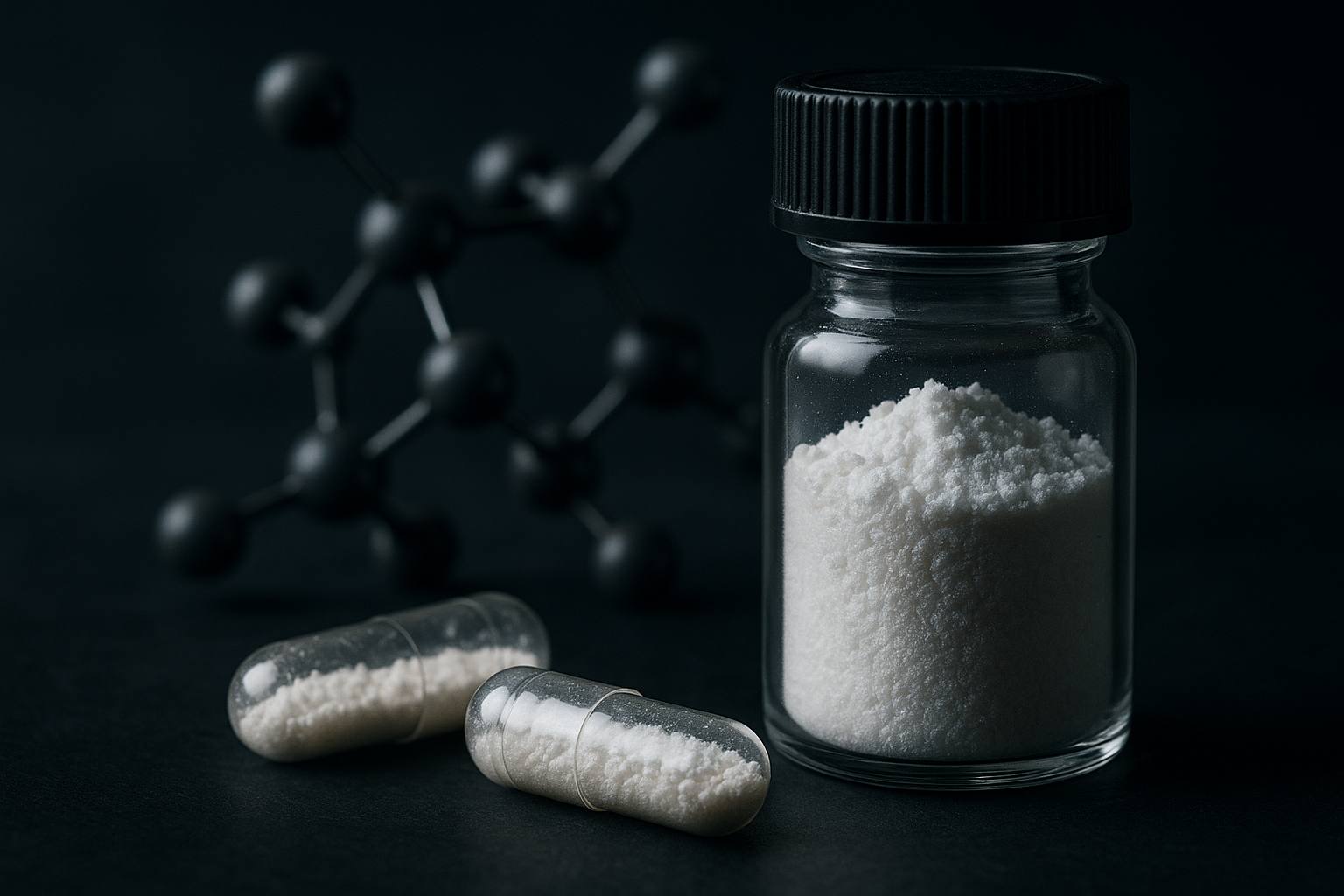
Creatine hcl
Creatine HCl is a form of creatine bound to hydrochloric acid, developed to increase solubility and potentially improve gastrointestinal tolerability compared with creatine monohydrate. It shares creatine’s physiological rationale: increasing phosphocreatine availability in muscle, supporting rapid ATP resynthesis during brief, intense efforts. However, the strongest evidence on creatine’s effectiveness comes mainly from creatine monohydrate; for the HCl form, comparative data are more limited.
Performance supplement: a salt form of creatine with high water solubility
Creatine HCl is a form of creatine bound to hydrochloric acid, developed to increase solubility and potentially improve gastrointestinal tolerability compared with creatine monohydrate. It shares the same physiological rationale as creatine: increasing the availability of phosphocreatine in muscle, supporting the rapid resynthesis of ATP during short, intense efforts. However, the strongest evidence on creatine’s effectiveness comes mainly from creatine monohydrate; for the HCl form, comparative data are more limited.
Mechanism of action
In muscle, phosphocreatine acts as an energy buffer: through creatine kinase, it donates a phosphate group to ADP to rapidly regenerate ATP during high-intensity, short-duration efforts. Increased intramuscular creatine may: (1) increase the capacity for ATP resynthesis in the first seconds of intense work; (2) improve the ability to maintain power/strength across repeated sets; (3) promote training adaptations by increasing the amount of work that can be tolerated; (4) increase intracellular hydration (osmotic effect), with a possible indirect anabolic signal. Once dissociated, the HCl form provides free creatine, which follows the same transporters (SLC6A8) and metabolic pathways as dietary/endogenous creatine.
Supported benefits
- Improved performance in repeated high-intensity exercise (sprinting, weightlifting, intermittent sports) by increasing phosphocreatine availability (strong)
- Increase in lean mass and strength over time when combined with resistance training (evidence mainly from creatine monohydrate; plausible transferability to HCl if muscle saturation is achieved) (moderate)
- Reduced perception of fatigue and better recovery between sets in some training contexts (heterogeneity of results; depends on protocol and population) (limited)
- Possible cognitive benefits under conditions of energetic stress (sleep deprivation, vegetarians/vegans, high-demand tasks), with more robust evidence for creatine in general than for HCl specifically (emerging)
Safety & side effects
- Gastrointestinal disturbances (nausea, cramps, diarrhea), often dose-dependent; HCl’s greater solubility may improve tolerability in some individuals, but this is not guaranteed
- Increase in body weight (mainly due to intracellular water retention in the first few weeks)
- Increase in serum creatinine due to non-enzymatic conversion of creatine: this may complicate the interpretation of kidney function tests without necessarily indicating kidney damage
- Rarely: headache or a feeling of bloating (anecdotal reports; causality not always clear)
FAQ
Is creatine HCl “better” than creatine monohydrate?
Creatine monohydrate is the form with the most evidence for efficacy and safety. HCl is more soluble and some people tolerate it better gastrointestinally, but it has not been conclusively shown to produce greater increases in muscle creatine or performance than monohydrate when the same amount of creatine is actually consumed.
Is a loading phase necessary?
A loading phase speeds up the saturation of muscle stores, but it is not essential: consistent intake at lower doses can also achieve saturation over a few weeks. Loading and maintenance protocols have been studied primarily with creatine monohydrate.
Does creatine damage the kidneys?
In healthy adults, studies on creatine monohydrate at studied doses do not consistently show kidney damage. However, in the presence of kidney disease or risk factors, clinical evaluation is necessary. In addition, creatine can increase serum creatinine and complicate test interpretation.
How much does timing matter (before or after training)?
In general, consistency over time matters more for saturating muscle stores. Taking it close to training may be practical, but the differences between pre- and post-workout are often small.
Is it normal to gain weight?
Yes, weight gain may occur in the first few weeks, often related to greater intracellular water. Over time, if combined with training, it may contribute to increases in lean mass.
The information provided is for informational and educational purposes only. It does not constitute medical advice. Use should be evaluated and authorized by a qualified healthcare professional.
Mechanism of action
In muscle, phosphocreatine acts as an energy buffer: via creatine kinase it donates a phosphate group to ADP to rapidly regenerate ATP during high-intensity, short-duration efforts. Increased intramuscular creatine can: (1) increase the capacity for ATP resynthesis in the first seconds of intense work; (2) improve the ability to maintain power/strength over repeated sets; (3) promote training adaptations by increasing the volume of work that can be tolerated; (4) increase intracellular hydration (osmotic effect) with a possible indirect anabolic signal. The HCl form, once dissociated, provides free creatine that follows the same transporters (SLC6A8) and metabolic pathways as dietary/endogenous creatine.
Scientific benefits
Contraindications
- Known kidney disease or reduced kidney function: clinical evaluation required before any use of creatine
- Pregnancy and breastfeeding: insufficient data to recommend use without medical supervision
- Pediatric/adolescent age: use only in clinical/sports contexts with qualified supervision and risk-benefit assessment
- History of significant intolerance to creatine supplements (major GI disturbances)
Side effects
- Gastrointestinal disturbances (nausea, cramps, diarrhea), often dose-dependent; the greater solubility of HCl may improve tolerability in some individuals, but this is not guaranteed
- Body weight gain (mainly due to intracellular water retention in the first weeks)
- Increased serum creatinine due to non-enzymatic conversion of creatine: this can confuse the interpretation of kidney function tests without necessarily indicating kidney damage
- Rarely: headache or a feeling of bloating (anecdotal reports; causality not always clear)
Interactions
- Potentially nephrotoxic drugs (e.g. some NSAIDs at high/prolonged doses, aminoglycosides, cyclosporine/tacrolimus): caution due to overall kidney load and clinical monitoring
- Diuretics: possible impact on hydration/electrolytes; caution
- Cimetidine and drugs that affect tubular secretion: may alter kidney markers and interpretation of test results
- Alcohol: may worsen hydration and recovery; it is not a specific interaction but may affect tolerability and performance
Regulatory status
Generally marketed as a dietary supplement. It is not a doping substance per se according to WADA lists, but supplements may be contaminated: for athletes subject to testing, it is important to choose products tested by third parties (e.g. anti-contamination certification programs). Regulations vary by country regarding labeling and claims.
Supplements and peptides
 Performance
Acetyl l-carnitine
Acetyl-L-carnitine (ALCAR) is a form of carnitine in which an acetyl group facilitates entry into tissues and the…
 Performance
Anhydrous betaine (trimethylglycine)
Anhydrous betaine (TMG) is a compound naturally present in various foods (e.g. beetroot, spinach, cereals) and also…
 Performance
Arginine akg
Arginine AKG (AAKG) combines L-arginine with α-ketoglutarate (AKG), an intermediate in the Krebs cycle. It is marketed…