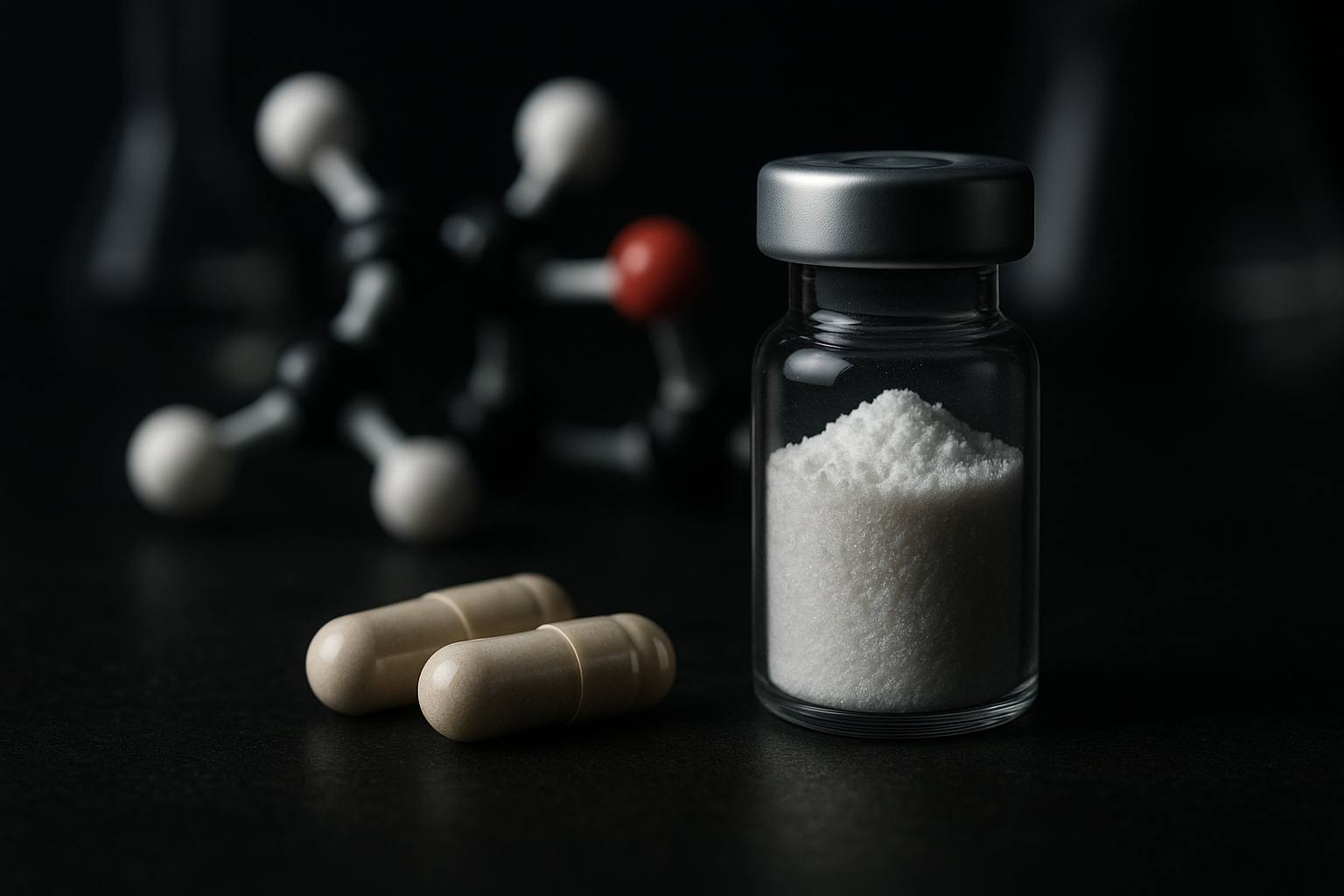
Creatine monohydrate
Creatine monohydrate is a stable and widely studied form of creatine, an endogenous compound involved in the phosphagen energy system (ATP–phosphocreatine). Supplementation increases intramuscular stores of total creatine and phosphocreatine, with documented effects on performance in short, intense exercise and on adaptations to strength training.
Ergogenic supplement with robust evidence for strength, power, and high-intensity performance
Creatine monohydrate is a stable and extensively studied form of creatine, an endogenous compound involved in the phosphagen energy system (ATP–phosphocreatine). Supplementation increases intramuscular stores of total creatine and phosphocreatine, with documented effects on performance in short, intense exercise and on adaptations to strength training.
Mechanism of action
1) Phosphagen system: increased intramuscular phosphocreatine, which donates phosphate groups to rapidly regenerate ATP during short, intense exercise. 2) Energy buffering and energy transport: support for the “creatine kinase shuttle” between sites of ATP production and utilization. 3) Indirect training effects: greater ability to sustain volume/intensity, with neuromuscular and hypertrophic adaptations in the medium term. 4) Cellular hydration: increased intracellular water (osmotic effect), which may contribute to changes in body mass and potentially to anabolic signaling (variable evidence). 5) Possible neuroenergetic effects: increased phosphocreatine stores in some tissues (e.g., brain) under specific conditions, with inconsistent results.
Supported benefits
- Increased maximal strength and performance in high-intensity, short-duration exercise (sprinting, weightlifting, repeated efforts) (strong)
- Increased power and repeated work capacity (e.g., multiple sets, intermittent sports) (strong)
- Increased lean mass in the context of resistance/strength training (partly due to intracellular water, partly due to greater training stimulus) (strong)
- Support for performance in older adults during strength training (function and muscle mass) (moderate)
- Possible support in some conditions of metabolic stress/reduced sleep or recovery, with heterogeneous results (limited)
- Potential neurocognitive effects in specific contexts (e.g., sleep deprivation, vegetarians/vegans), with inconclusive evidence (emerging)
Safety & side effects
- Increase in body mass (often 0.5–2 kg in the first weeks), mainly due to increased intracellular water
- Gastrointestinal disturbances (nausea, cramps, diarrhea), especially with high doses or when taken in a single serving
- Possible worsening of symptoms in individuals predisposed to perceived water retention (not necessarily pathological)
- Increase in serum creatinine as a laboratory marker (it may reflect greater conversion to creatinine and not necessarily kidney damage)
FAQ
Is creatine monohydrate different from other forms (HCl, ethyl ester, “buffered”)?
Monohydrate is the form with the greatest number of studies and a very favorable efficacy/safety/cost ratio. Many alternative forms do not show consistent advantages in terms of increasing muscle stores or performance compared with monohydrate when tested under controlled conditions.
Is a loading phase necessary?
The loading phase speeds up saturation of muscle stores, but it is not essential: protocols without a loading phase can achieve saturation over a longer period with lower daily doses.
Is it harmful to the kidneys?
In healthy adults, studies generally do not show kidney damage at the doses studied. However, in the presence of kidney disease, risk factors, or the use of nephrotoxic drugs, an individual medical assessment is necessary. In addition, creatinine may increase and complicate the interpretation of test results.
Does it cause cramps or dehydration?
The evidence does not consistently support an increase in cramps or dehydration in athletes; increased intracellular water is common. Tolerability depends on dose, method of intake, and hydration.
Is it useful in endurance sports?
The benefits are more solid for short, intense efforts. In pure endurance, the effect is less predictable and the increase in body mass may be a disadvantage in some disciplines; it may be more relevant in endurance sports with sprint components or repeated high-intensity efforts.
Who responds less to creatine?
Individuals with already high initial muscle stores (often heavy consumers of meat/fish) may show smaller increases. Genetic variability, fiber type, and training protocol also influence the response.
The information provided is for informational and educational purposes only. It does not constitute medical advice. Use should be assessed and authorized by a qualified healthcare professional.
Mechanism of action
1) Phosphagen system: increased intramuscular phosphocreatine, which donates phosphate groups to rapidly regenerate ATP during short, intense exercise. 2) Energy buffer and energy transport: support for the “creatine kinase shuttle” between sites of ATP production and use. 3) Indirect effects on training: greater ability to sustain volume/intensity, with neuromuscular and hypertrophic adaptations over the medium term. 4) Cellular hydration: increased intracellular water (osmotic effect), which may contribute to changes in body mass and potentially to anabolic signaling (variable evidence). 5) Possible neuroenergetic effects: increased phosphocreatine stores in some tissues (e.g. brain) under specific conditions, with inconsistent results.
Scientific benefits
Contraindications
- Known kidney disease or reduced kidney function: requires individual clinical evaluation
- States of dehydration or conditions that increase the risk of fluid-electrolyte imbalances: caution
- Pregnancy and breastfeeding: insufficient data for general recommendations
- Pediatric age: use only in highly controlled clinical/sports settings and with medical supervision
Side effects
- Increase in body mass (often 0.5–2 kg in the first weeks) mainly due to increased intracellular water
- Gastrointestinal disturbances (nausea, cramps, diarrhea), especially with high doses or when taken in a single administration
- Possible worsening of symptoms in subjects predisposed to perceived fluid retention (not necessarily pathological)
- Increase in serum creatinine as a laboratory marker (may reflect greater conversion to creatinine and not necessarily kidney damage)
Interactions
- Potentially nephrotoxic drugs (e.g. some NSAIDs at high/prolonged doses, aminoglycosides, cyclosporine/tacrolimus): caution due to overall kidney risk
- Diuretics: possible impact on hydration and electrolyte balance; caution
- Cimetidine/trimethoprim and other drugs that affect creatinine/clearance: may complicate the interpretation of kidney markers
- Excess alcohol and weight-cutting/dehydration strategies: may increase risks related to hydration and performance
Regulatory status
Dietary supplement legally marketed in many countries; not prohibited by WADA. Regulations on purity, claims, and dosages vary by country. Products with third-party certifications (e.g. Informed-Sport/NSF) are preferable to reduce the risk of contaminants.
Supplements and peptides
 Performance
Acetyl l-carnitine
Acetyl-L-carnitine (ALCAR) is a form of carnitine in which an acetyl group facilitates entry into tissues and the…
 Performance
Anhydrous betaine (trimethylglycine)
Anhydrous betaine (TMG) is a compound naturally present in various foods (e.g. beetroot, spinach, cereals) and also…
 Performance
Arginine akg
Arginine AKG (AAKG) combines L-arginine with α-ketoglutarate (AKG), an intermediate in the Krebs cycle. It is marketed…