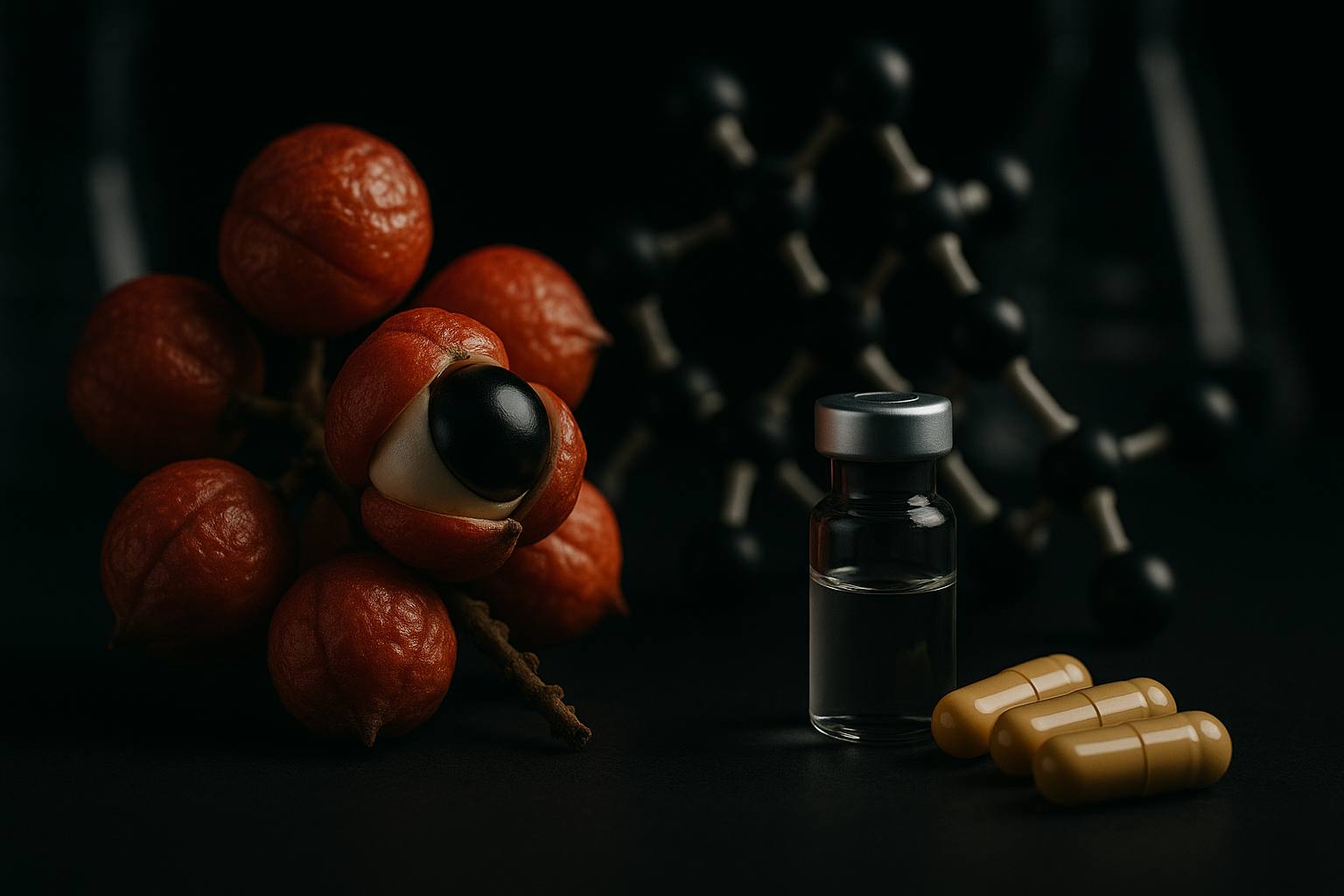
Guaranà
Guaranà is a plant extract obtained from the seeds of Paullinia cupana, traditionally used as a tonic. In the “Focus & Nootropics” field, it is used mainly for its caffeine content (often high) and for the presence of polyphenols (catechins, proanthocyanidins), which may modulate the absorption and effects of caffeine. The effects observed in human studies largely overlap with those of caffeine, with possible differences related to the phytochemical matrix and extract standardization.
Stimulating phytocompound rich in methylxanthines for attention and alertness
Guarana is a botanical extract obtained from the seeds of Paullinia cupana, traditionally used as a tonic. In the “Focus & Nootropics” field, it is used primarily for its caffeine content (often high) and for the presence of polyphenols (catechins, proanthocyanidins), which may modulate the absorption and effects of caffeine. The effects observed in human studies largely overlap with those of caffeine, with possible differences related to the phytochemical matrix and the standardization of the extract.
Mechanism of action
Main mechanism: competitive antagonism of adenosine receptors (A1 and A2A) by caffeine, with increased alertness and reduced perception of fatigue. Secondary effects: modulation of dopaminergic and noradrenergic neurotransmission (indirect), increased release of catecholamines, and a slight increase in thermogenesis. Guarana polyphenols may contribute antioxidant and vascular effects and may influence caffeine kinetics (potentially more gradual release in some formulations), but the evidence indicates that the stimulant component is dominated by caffeine.
Supported benefits
- Increased alertness and reduced drowsiness (stimulant effect attributable to the caffeine content) (strong)
- Improved attention and reaction times in cognitive tasks, especially under conditions of fatigue (moderate)
- Reduced perception of fatigue and mild support for endurance performance (caffeine-dependent effect) (moderate)
- Possible effects on mood/perceived energy and mental fatigue with low-caffeine extracts in some trials (limited)
- Antioxidant/vascular support linked to polyphenols (intermediate markers rather than clinical outcomes) (emerging)
Safety & side effects
- Insomnia or worsening sleep quality
- Anxiety, irritability, nervousness, agitation
- Tachycardia, palpitations, increased blood pressure (especially in sensitive individuals)
- Gastrointestinal disturbances (nausea, reflux, diarrhea)
- Tremors, headache
- Tolerance with repeated use and withdrawal symptoms (headache, drowsiness, irritability) when reducing/stopping caffeine
- Rare serious adverse events are generally associated with excessive total caffeine intake or predisposing conditions
FAQ
Is guarana different from coffee?
The main difference is the matrix: in guarana, caffeine is associated with polyphenols and tannins, and the percentage of caffeine in the seeds can be high. In practice, many effects on focus and alertness overlap with those of caffeine; what often changes is the actual dose and the perceived kinetics depending on the formulation.
Why do some guarana products “seem” stronger?
Often because of a higher-than-expected caffeine content or because it is combined with other caffeine sources in the same product. Standardization (mg of caffeine per dose) is the most informative factor.
Does guarana improve memory?
The strongest evidence concerns attention, alertness, and reaction times. For long-term memory and learning, the results are more variable and often confounded by caffeine’s general effect on arousal and fatigue.
Does it cause dependence?
Caffeine can induce tolerance and withdrawal symptoms (e.g., headache, drowsiness) in some individuals. This does not necessarily equate to clinical dependence, but it does indicate possible physiological adaptation to regular use.
Is it suitable for evening use?
In many individuals, caffeine reduces sleep quality even when taken several hours before bedtime, due to its variable half-life. Individual sensitivity is decisive.
The information provided is for informational and educational purposes only. It does not constitute medical advice. Use must be evaluated and authorized by a qualified healthcare professional.
Mechanism of action
Main mechanism: competitive antagonism of adenosine receptors (A1 and A2A) by caffeine, with increased alertness and reduced perception of fatigue. Secondary effects: modulation of dopaminergic and noradrenergic neurotransmission (indirect), increased release of catecholamines, and a slight increase in thermogenesis. Guaranà polyphenols may contribute to antioxidant and vascular effects and may influence caffeine kinetics (potentially more gradual release in some formulations), but the evidence indicates that the stimulant component is dominated by caffeine.
Scientific benefits
Contraindications
- Pregnancy and breastfeeding: caution due to caffeine; discuss individual limits with a healthcare professional
- Anxiety disorders, panic attacks, or insomnia: possible worsening
- Known arrhythmias, heart disease, uncontrolled hypertension: risk of cardiovascular effects from stimulants
- Peptic ulcer or significant gastroesophageal reflux: possible worsening of symptoms
- Pediatric/adolescent age: greater caution due to sensitivity to stimulants and cumulative exposure from beverages
- Uncontrolled hyperthyroidism: possible increase in adrenergic symptoms
Side effects
- Insomnia or worsening sleep quality
- Anxiety, irritability, nervousness, agitation
- Tachycardia, palpitations, increased blood pressure (especially in sensitive individuals)
- Gastrointestinal disturbances (nausea, reflux, diarrhea)
- Tremors, headache
- Tolerance with repeated use and withdrawal symptoms (headache, drowsiness, irritability) when reducing/stopping caffeine
- Rare serious adverse events are generally associated with excessive total caffeine intake or predisposing conditions
Interactions
- Other sources of caffeine (coffee, tea, mate, energy drinks, pre-workouts): increased total load and risk of adverse effects
- Stimulants/sympathomimetics (e.g. pseudoephedrine): possible increase in tachycardia and blood pressure
- Drugs that reduce caffeine metabolism (CYP1A2 inhibitors such as fluvoxamine; some quinolone antibiotics can also increase caffeine levels): risk of amplified effects
- Tobacco smoking (CYP1A2 induction): may reduce caffeine half-life; smoking cessation may increase exposure at the same dose
- Alcohol: may mask the perception of sedation; combinations in beverages may increase risk-taking behaviors
- Anticoagulants/antiplatelets: polyphenols and caffeine may variably affect some parameters; caution during therapy and clinical monitoring when indicated
- Lithium: caffeine may influence plasma levels through effects on clearance; requires clinical caution
Regulatory status
In many regions (including the EU/Italy), guaranà is marketed as a food ingredient and in supplements; caffeine is subject to labeling requirements in specific categories (e.g. beverages with high caffeine content) and to general food safety regulations. Policies may vary by country and product category.
Supplements and peptides
 Focus & Nootropics
Agmatine sulfate
Agmatine is an endogenous metabolite produced by decarboxylation of L-arginine. In supplementation contexts it is…
 Focus & Nootropics
Alpha-gpc
Alpha-GPC is a choline-containing compound (a precursor of acetylcholine) and an intermediate in phospholipid…
 Focus & Nootropics
Anhydrous caffeine
Anhydrous caffeine is the dehydrated form of caffeine, used in supplements for its high concentration and dosing…