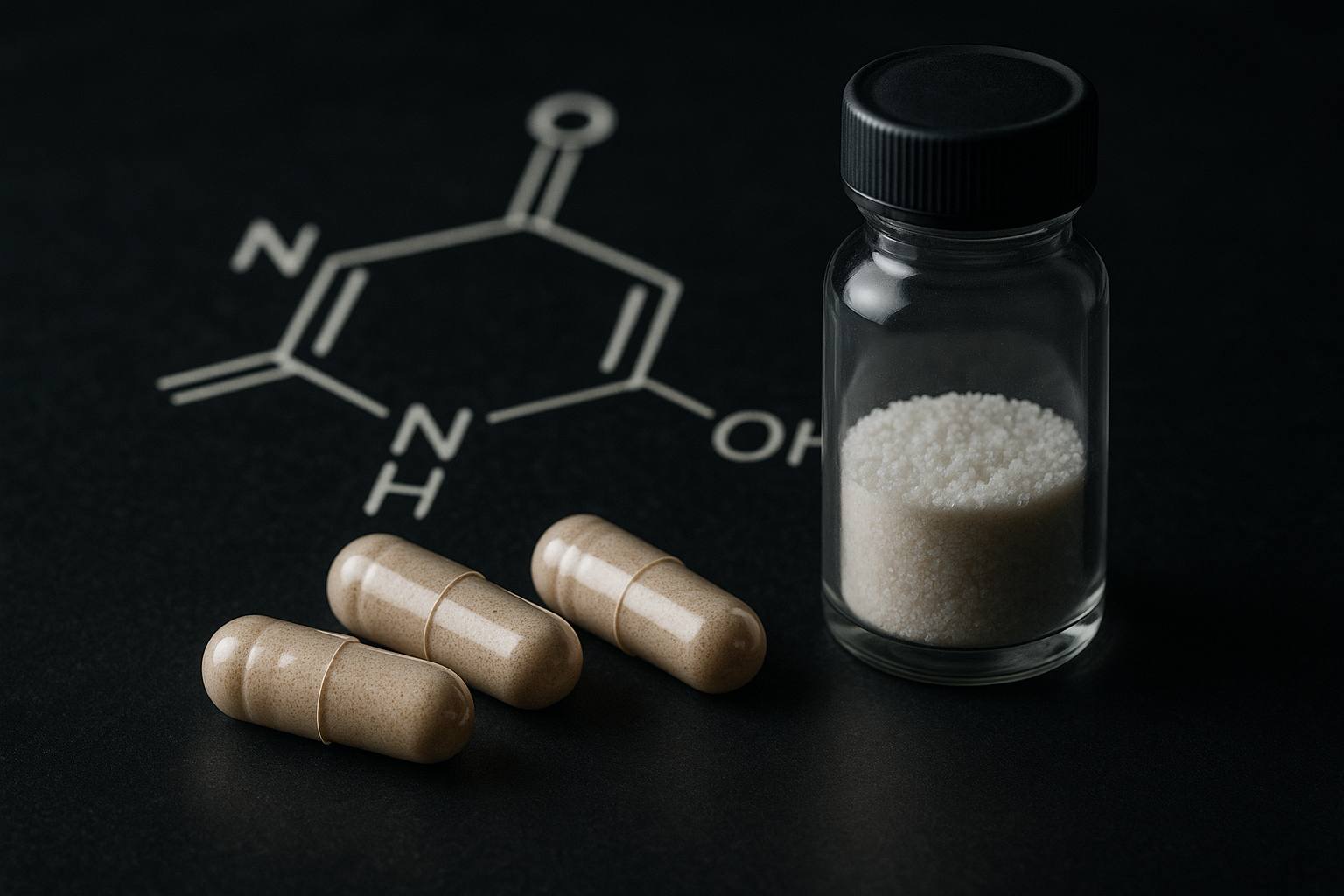
Niacin (vitamin B3)
Niacin (vitamin B3) mainly includes nicotinic acid and nicotinamide. It is essential for the synthesis of the coenzymes NAD and NADP, which are central to energy production, DNA repair, and redox regulation. In the “Focus & Nootropics” field, interest stems from NAD’s role in brain metabolism; however, evidence of cognitive improvement in healthy individuals is limited, and the risks (e.g. flushing and potential hepatotoxicity at high doses) require particular caution.
Precursor of NAD/NADP: cellular energy, metabolism, and neuronal function
Niacin (vitamin B3) mainly includes nicotinic acid and nicotinamide. It is essential for the synthesis of the coenzymes NAD and NADP, which are central to energy production, DNA repair, and redox regulation. In the “Focus & Nootropics” field, interest stems from the role of NAD in brain metabolism; however, evidence of cognitive improvement in healthy individuals is limited, and the risks (e.g. flushing and potential hepatotoxicity at high doses) require particular caution.
Mechanism of action
After absorption, nicotinic acid and nicotinamide are converted into NAD/NADP through salvage pathways and de novo synthesis (from tryptophan). NAD acts as a redox coenzyme (NAD+/NADH) and as a substrate for NAD-consuming enzymes (e.g. sirtuins, PARP, CD38), involved in DNA repair, epigenetic regulation, and calcium signaling. Nicotinic acid, at pharmacological doses, also activates the GPR109A (HCAR2) receptor on immune cells and adipocytes, contributing to effects on lipolysis and inflammatory mediators; activation of GPR109A is associated with “flushing” via prostaglandins. Nicotinamide does not significantly activate GPR109A and generally does not cause flushing, but at high doses it can still produce adverse effects (e.g. gastrointestinal, hepatic in some contexts).
Supported benefits
- Correction/prevention of vitamin B3 deficiency and pellagra (in contexts of insufficient intake or malabsorption) (strong)
- Support for energy metabolism through increased availability of NAD/NADP (basic biology is well established; translation into improved cognitive performance in healthy individuals has not been robustly demonstrated) (moderate)
- Effects on lipid profile with nicotinic acid at pharmacological doses (reduction in triglycerides and LDL, increase in HDL), but with clinical limitations and tolerability issues; this is not a nootropic benefit (strong)
- Possible reduction in certain dermatological outcomes (e.g. prevention of some non-melanoma skin cancers with nicotinamide in high-risk populations), not directly related to the focus (moderate)
- Improvement in attention/memory in healthy individuals or as a nootropic: direct evidence is limited; any benefits are more plausible in cases of deficiency or increased requirement (limited)
Safety & side effects
- Flushing (redness, warmth, itching), more common with immediate-release nicotinic acid; mediated by prostaglandins
- Gastrointestinal disturbances (nausea, dyspepsia, diarrhea)
- Headache, dizziness
- Increased liver enzymes and hepatotoxicity (greater risk with high doses and some extended-release formulations)
- Worsening of glycemic control/insulin resistance in some individuals at high doses
- Hyperuricemia and possible worsening of gout at high doses
- Rare: myopathy, especially in combination with other lipid-lowering drugs
FAQ
Are niacin and niacinamide the same thing?
They are different forms of vitamin B3. Both contribute to the synthesis of NAD/NADP, but nicotinic acid (niacin) activates GPR109A and is more associated with flushing and pharmacological effects on lipids; nicotinamide (niacinamide) generally does not cause flushing and has a different action profile.
Does niacin really improve focus and memory?
The biological foundations (the role of NAD in neuronal metabolism) are solid, but evidence of measurable improvement in focus/memory in healthy people with adequate vitamin B3 intake is limited. Benefits are more plausible in cases of deficiency or increased requirement.
What is the “niacin flush” and why does it happen?
It is a vasodilation reaction with redness and a sensation of warmth/itching, typical of nicotinic acid. It is mediated in part by the release of prostaglandins following activation of receptors such as GPR109A.
Are extended-release forms safer?
Not necessarily. They may reduce flushing, but some extended-release formulations have been associated with a higher risk of liver abnormalities compared with immediate-release forms, especially at high doses.
What are the signs of possible intolerance or risk?
Severe flushing, persistent nausea, abdominal pain, dark urine, jaundice, marked fatigue, or generalized itching may be signs of problems (particularly liver-related) and require clinical evaluation.
The information provided is for informational and educational purposes only. It does not constitute medical advice. Use must be evaluated and authorized by a qualified healthcare professional.
Mechanism of action
After absorption, nicotinic acid and nicotinamide are converted into NAD/NADP through salvage pathways and de novo synthesis (from tryptophan). NAD acts as a redox coenzyme (NAD+/NADH) and as a substrate for NAD-consuming enzymes (e.g. sirtuins, PARP, CD38), involved in DNA repair, epigenetic regulation, and calcium signaling. Nicotinic acid, at pharmacological doses, also activates the GPR109A (HCAR2) receptor on immune cells and adipocytes, contributing to effects on lipolysis and inflammatory mediators; activation of GPR109A is associated with “flushing” via prostaglandins. Nicotinamide does not significantly activate GPR109A and tends not to cause flushing, but at high doses it can still cause adverse effects (e.g. gastrointestinal, hepatic in some contexts).
Scientific benefits
Contraindications
- Active liver disease or persistently elevated transaminases (increased risk with high doses)
- Active peptic ulcer disease (possible worsening of gastrointestinal symptoms)
- Gout or uncontrolled hyperuricemia (risk of increased uric acid)
- Uncontrolled diabetes or high metabolic risk (possible worsening of blood glucose at high doses)
- Known hypersensitivity to niacin or excipients
- Pregnancy/breastfeeding: avoid pharmacological doses unless clinically indicated and supervised
Side effects
- Flushing (redness, warmth, itching), more common with immediate-release nicotinic acid; mediated by prostaglandins
- Gastrointestinal disturbances (nausea, dyspepsia, diarrhea)
- Headache, dizziness
- Elevated liver enzymes and hepatotoxicity (greater risk with high doses and some extended-release formulations)
- Worsening of glycemic control/insulin resistance in some individuals at high doses
- Hyperuricemia and possible worsening of gout at high doses
- Rare: myopathy, especially in combination with other lipid-lowering drugs
Interactions
- Statins and other lipid-lowering agents: increased risk of myopathy/rhabdomyolysis in some contexts (especially with high-dose nicotinic acid)
- Alcohol: increases risk of hepatotoxicity and may worsen flushing
- Hepatotoxic drugs: potential increased risk of liver damage
- Antidiabetics/insulin: possible need for clinical adjustments if high-dose niacin worsens blood glucose (interaction of medical relevance)
- Antihypertensives/vasodilators: flushing and vasodilation may increase the risk of symptomatic hypotension in predisposed individuals
- Anticoagulants/antiplatelets: reports of increased bleeding risk with high doses in some contexts; clinical relevance should be assessed case by case
Regulatory status
Vitamin B3 is available as a dietary supplement in many jurisdictions. High doses and therapeutic indications (e.g. dyslipidemia) often fall within the medical/pharmacological domain; status may vary by country, formulation, and claims.
Supplements and peptides
 Focus & Nootropics
Agmatine sulfate
Agmatine is an endogenous metabolite produced by decarboxylation of L-arginine. In supplementation contexts it is…
 Focus & Nootropics
Alpha-gpc
Alpha-GPC is a choline-containing compound (a precursor of acetylcholine) and an intermediate in phospholipid…
 Focus & Nootropics
Anhydrous caffeine
Anhydrous caffeine is the dehydrated form of caffeine, used in supplements for its high concentration and dosing…