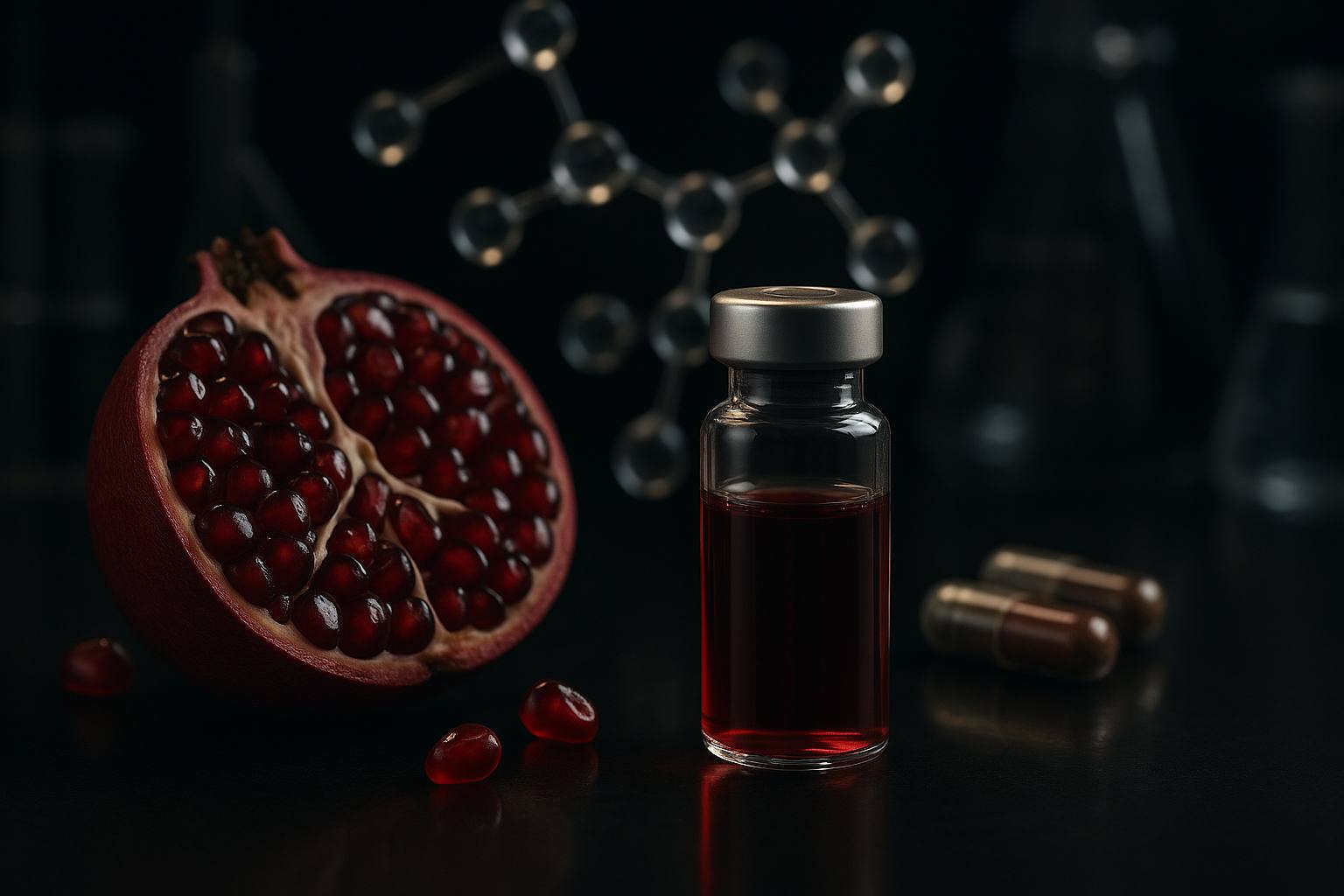
Pomegranate extract
Pomegranate extract is a plant-based supplement obtained from the juice, peel, or arils of the fruit. The main bioactive compounds include ellagitannins (particularly punicalagins), ellagic acid, and anthocyanins. In the “Focus & Nootropics” context, interest derives mainly from vascular and antioxidant mechanisms that may support cerebral perfusion and resilience to oxidative stress; however, direct evidence on attention/memory in humans is still limited.
A phytocompound rich in ellagitannins (punicalagins) with potential effects on endothelial function, inflammation, and oxidative stress, with indirect implications for cognitive performance.
Pomegranate extract is a plant-derived supplement obtained from the juice, peel, or arils of the fruit. The main bioactive compounds include ellagitannins (particularly punicalagins), ellagic acid, and anthocyanins. In the “Focus & Nootropics” context, interest stems mainly from vascular and antioxidant mechanisms that may support cerebral perfusion and resilience to oxidative stress; however, direct evidence on attention/memory in humans is still limited.
Mechanism of action
Proposed mechanisms (mainly from preclinical studies and clinical studies on cardiovascular/metabolic endpoints): - Modulation of oxidative stress: increased plasma antioxidant capacity and reduced biomarkers of lipid oxidation in some studies; polyphenols also act as modulators of redox pathways (not just “scavengers”). - Endothelial/vascular effects: possible increase in nitric oxide (NO) bioavailability and improvement in endothelial function (e.g. FMD) in some contexts; potential reduction in blood pressure in specific populations. - Inflammatory modulation: reduction of pro-inflammatory signals (e.g. NF-κB) observed mainly in preclinical models; in humans, heterogeneous results for CRP/cytokines. - Urolithin metabolites: possible effects on mitochondria, autophagy/mitophagy, and inflammation in experimental models; clinical transferability depends on the “metabotype.” - Potential indirect neuroprotection: improvement in vascular profile and reduction of oxidative stress could favor perfusion and neuronal resilience; direct clinical evidence on cognition is still inconclusive.
Supported benefits
- Support for endothelial function and some vascular markers (in specific populations and with standardized products) (moderate)
- Reduction in blood pressure (especially systolic) in some studies on juice/extracts; average effect small and variable (moderate)
- Improvement in biomarkers of oxidative stress (e.g. lipid oxidation) in some contexts (moderate)
- Effects on memory/attention or cognitive performance in healthy subjects: preliminary and inconsistent results (limited)
- Support for recovery/exercise response (DOMS, post-exercise inflammation) with heterogeneous results (limited)
Safety & side effects
- Gastrointestinal disturbances (nausea, cramps, diarrhea), especially with high doses or concentrated juices
- Headache or nonspecific sensations (rare, nonspecific)
- Allergic reactions (rare) in subjects sensitive to pomegranate
FAQ
Is it a true nootropic for focus and memory?
The strongest evidence concerns vascular/antioxidant effects. Studies that directly measure attention, memory, or cognitive performance in humans are still few and show inconsistent results; any benefit for focus is plausibly indirect (perfusion, oxidative stress) and not guaranteed.
Does juice or extract matter more?
Juice is a food matrix with wide variability in polyphenols and sugars; extracts may be more standardized (e.g. in punicalagins/ellagitannins) and therefore more reproducible in studies. The choice affects tolerability, caloric intake, and comparability with the literature.
Why are responses so different between people?
An important part of the systemic effects may depend on the transformation of polyphenols into urolithins by the microbiota. Individual differences in the microbiota (“metabotypes”) can change the quantity and type of metabolites produced, influencing the response.
Is it safe together with blood pressure medications or blood thinners?
Additive effects on blood pressure and potential interactions (not always predictable) with cardiovascular therapies or anticoagulants/antiplatelet agents are possible. In these cases, professional evaluation and possible clinical monitoring are prudent.
The information provided is for informational and educational purposes only. It does not constitute medical advice. Use must be evaluated and authorized by a qualified healthcare professional.
Mechanism of action
Proposed mechanisms (mainly from preclinical studies and clinical studies on cardiovascular/metabolic endpoints): - Modulation of oxidative stress: increased plasma antioxidant capacity and reduction of biomarkers of lipid oxidation in some studies; polyphenols also act as modulators of redox pathways (not just “scavengers”). - Endothelial/vascular effects: possible increase in nitric oxide (NO) bioavailability and improvement in endothelial function (e.g. FMD) in some contexts; potential reduction in blood pressure in specific populations. - Inflammatory modulation: reduction of pro-inflammatory signals (e.g. NF-κB) observed mainly in preclinical models; in humans, heterogeneous results on CRP/cytokines. - Urolithin metabolites: possible effects on mitochondria, autophagy/mitophagy, and inflammation in experimental models; clinical transferability depends on the “metabotype.” - Potential indirect neuroprotection: improvement in vascular profile and reduction of oxidative stress could support perfusion and neuronal resilience; direct clinical evidence on cognition is still inconclusive.
Scientific benefits
Contraindications
- Pregnancy and breastfeeding: insufficient data for concentrated extracts; caution advised
- Known allergy to pomegranate or formulation components
- Conditions in which changes in blood pressure may be problematic: requires individual clinical evaluation
- Significant liver or kidney disease: limited data on high-concentration extracts; caution advised
Side effects
- Gastrointestinal disturbances (nausea, cramps, diarrhea), especially with high doses or concentrated juices
- Headache or nonspecific sensations (rare, nonspecific)
- Allergic reactions (rare) in subjects sensitive to pomegranate
Interactions
- Antihypertensives: possible additive effect on blood pressure in some subjects
- Anticoagulants/antiplatelets: clinical evidence is inconclusive, but caution is advised due to potential effects on hemostasis and for pharmacokinetic interactions that are not well defined
- Drugs metabolized by CYP (e.g. CYP3A4/CYP2C9): conflicting data and product-dependent; caution and clinical monitoring if undergoing treatment
- Statins and other cardiovascular drugs: possible theoretical/variable interactions; clinical relevance not clarified
Regulatory status
Marketed as a dietary supplement/botanical ingredient in many regions (EU/USA) with limitations on health claims. Not authorized as a treatment for diseases. Compliance depends on the quality, safety, and labeling standards of the individual product.
Supplements and peptides
 Focus & Nootropics
Agmatine sulfate
Agmatine is an endogenous metabolite produced by decarboxylation of L-arginine. In supplementation contexts it is…
 Focus & Nootropics
Alpha-gpc
Alpha-GPC is a choline-containing compound (a precursor of acetylcholine) and an intermediate in phospholipid…
 Focus & Nootropics
Anhydrous caffeine
Anhydrous caffeine is the dehydrated form of caffeine, used in supplements for its high concentration and dosing…