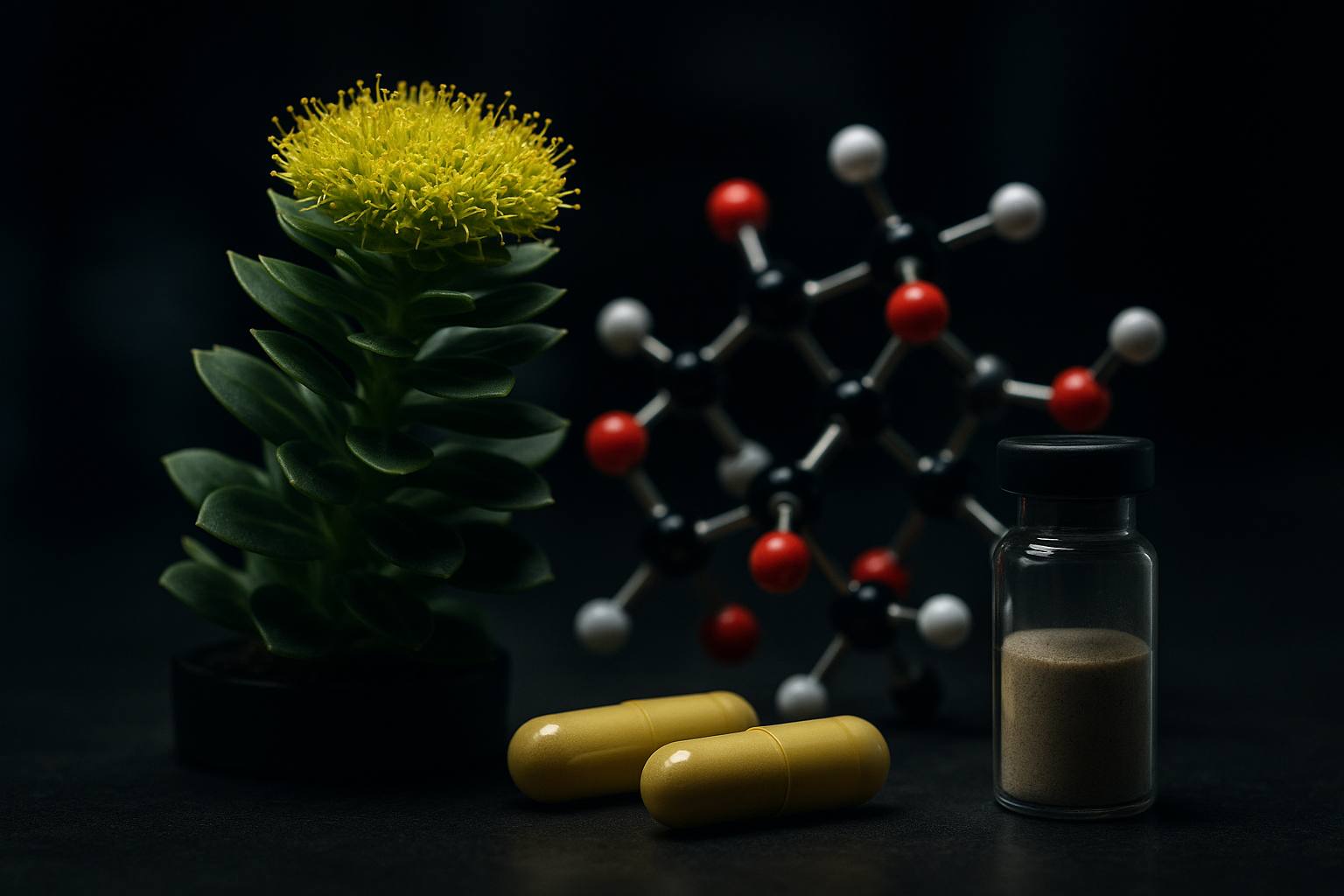
Rhodiola rosea
Rhodiola rosea (rhodiola root) is an adaptogenic plant traditionally used to support resilience to stress and reduce the sensation of fatigue. Standardized extracts (often for rosavins and salidroside) are the most studied. Clinical evidence suggests benefits especially for fatigue and perceived stress, with more variable results for physical performance.
Adaptogenic phytocompound studied for stress, fatigue, and cognitive/psychophysical performance
Rhodiola rosea (rhodiola root) is an adaptogenic plant traditionally used to support resilience to stress and reduce feelings of fatigue. Standardized extracts (often standardized for rosavins and salidroside) are the most studied. Clinical evidence suggests benefits mainly for fatigue and perceived stress, with more variable results for physical performance.
Mechanism of action
Proposed mechanisms (not all definitively confirmed in humans): modulation of the hypothalamic-pituitary-adrenal (HPA) axis and the stress response; possible influence on monoaminergic neurotransmission (serotonin, dopamine, norepinephrine) and endogenous opioid peptides; indirect antioxidant/anti-inflammatory activity and support for mitochondrial function and cellular energy metabolism; potential reduction in perceived exertion and improved tolerance to acute stress. Its action is likely multifactorial and dependent on the phytocomplex.
Supported benefits
- Reduction of fatigue and improvement of stress-related symptoms (mental fatigue, mild burnout, perceived stress) in some populations (moderate)
- Improvement in certain cognitive domains under stress (attention, processing speed, performance on mental tasks) in selected studies (limited)
- Support for physical performance (endurance, time to exhaustion, perceived exertion) with heterogeneous results across studies (limited)
- Possible improvement in mood under conditions of mild stress or mild depressive symptoms (not as a treatment for major depression) (emerging)
Safety & side effects
- Insomnia or disturbed sleep (especially if taken late or in sensitive individuals)
- Irritability, agitation, nervousness, or a feeling of “overactivation”
- Headache or dizziness
- Gastrointestinal disturbances (nausea, abdominal discomfort)
- Dry mouth (occasionally reported)
FAQ
Is Rhodiola rosea a “stimulant” like caffeine?
It is not a classic stimulant. It is often described as an adaptogen: it may reduce fatigue and improve tolerance to stress, but in some people it may feel activating and worsen insomnia or anxiety, especially if combined with stimulants.
Does standardization (rosavins/salidroside) matter?
Yes. Many studies use standardized extracts; non-standardized products may have different chemical profiles and therefore less predictable effects and tolerability.
Is it useful for sports performance?
The evidence is mixed. Some studies report improvements in endurance or perceived exertion, while others find no differences. The benefits appear more consistent for fatigue/stress than for pure athletic parameters.
How long does it take to notice effects?
Some studies observe effects even after acute intake on mental tasks or perceived fatigue; other protocols assess weeks of use. Individual variability is high.
Can it interfere with sleep?
Yes, in some individuals it may increase alertness or cause insomnia, especially if taken in the afternoon/evening or at higher doses within the studied range.
The information provided is for informational and educational purposes only. It does not constitute medical advice. Use should be evaluated and authorized by a qualified healthcare professional.
Mechanism of action
Proposed mechanisms (not all definitively confirmed in humans): modulation of the hypothalamic-pituitary-adrenal (HPA) axis and the stress response; possible influence on monoaminergic neurotransmission (serotonin, dopamine, norepinephrine) and on endogenous opioid peptides; indirect antioxidant/anti-inflammatory activity and support for mitochondrial function and cellular energy metabolism; potential reduction in perceived exertion and improvement in tolerance to acute stress. The action is likely multifactorial and dependent on the phytocomplex.
Scientific benefits
Contraindications
- Pregnancy and breastfeeding: insufficient safety data
- Bipolar disorder or history of mania/hypomania: potential risk of mood activation
- Marked anxiety disorders or significant insomnia: possible worsening in some individuals
- Pediatric age: insufficient evidence and safety data
- Complex medical conditions or multiple drug therapy: requires professional evaluation due to interaction risk
Side effects
- Insomnia or disturbed sleep (especially if taken late or in sensitive individuals)
- Irritability, agitation, nervousness, or a feeling of “hyperactivation”
- Headache or dizziness
- Gastrointestinal disturbances (nausea, abdominal discomfort)
- Dry mouth (reported occasionally)
Interactions
- Antidepressants (SSRIs/SNRIs/MAOIs and others): possible pharmacodynamic interaction on monoaminergic systems; theoretical risk of agitation or neuropsychiatric adverse effects
- Stimulants (e.g. amphetamines, methylphenidate) and high doses of caffeine: possible additive activating effects (tachycardia, anxiety, insomnia)
- Sedative/hypnotic drugs: possible functional antagonism in some individuals (the “activating” effect of rhodiola)
- Anticoagulants/antiplatelet agents: limited data; caution due to possible effects on hemostasis reported for some phytocompounds (evidence not conclusive)
- Drugs metabolized by CYP: in vitro/animal evidence is not always transferable; caution in the case of drugs with a narrow therapeutic index
Regulatory status
Marketed as a dietary supplement in many jurisdictions (EU/USA). Not approved as a drug for clinical indications. Health claims are subject to local regulations; standardization and quality controls depend on the manufacturer.
Supplements and peptides
 Performance
Acetyl l-carnitine
Acetyl-L-carnitine (ALCAR) is a form of carnitine in which an acetyl group facilitates entry into tissues and the…
 Performance
Anhydrous betaine (trimethylglycine)
Anhydrous betaine (TMG) is a compound naturally present in various foods (e.g. beetroot, spinach, cereals) and also…
 Performance
Arginine akg
Arginine AKG (AAKG) combines L-arginine with α-ketoglutarate (AKG), an intermediate in the Krebs cycle. It is marketed…