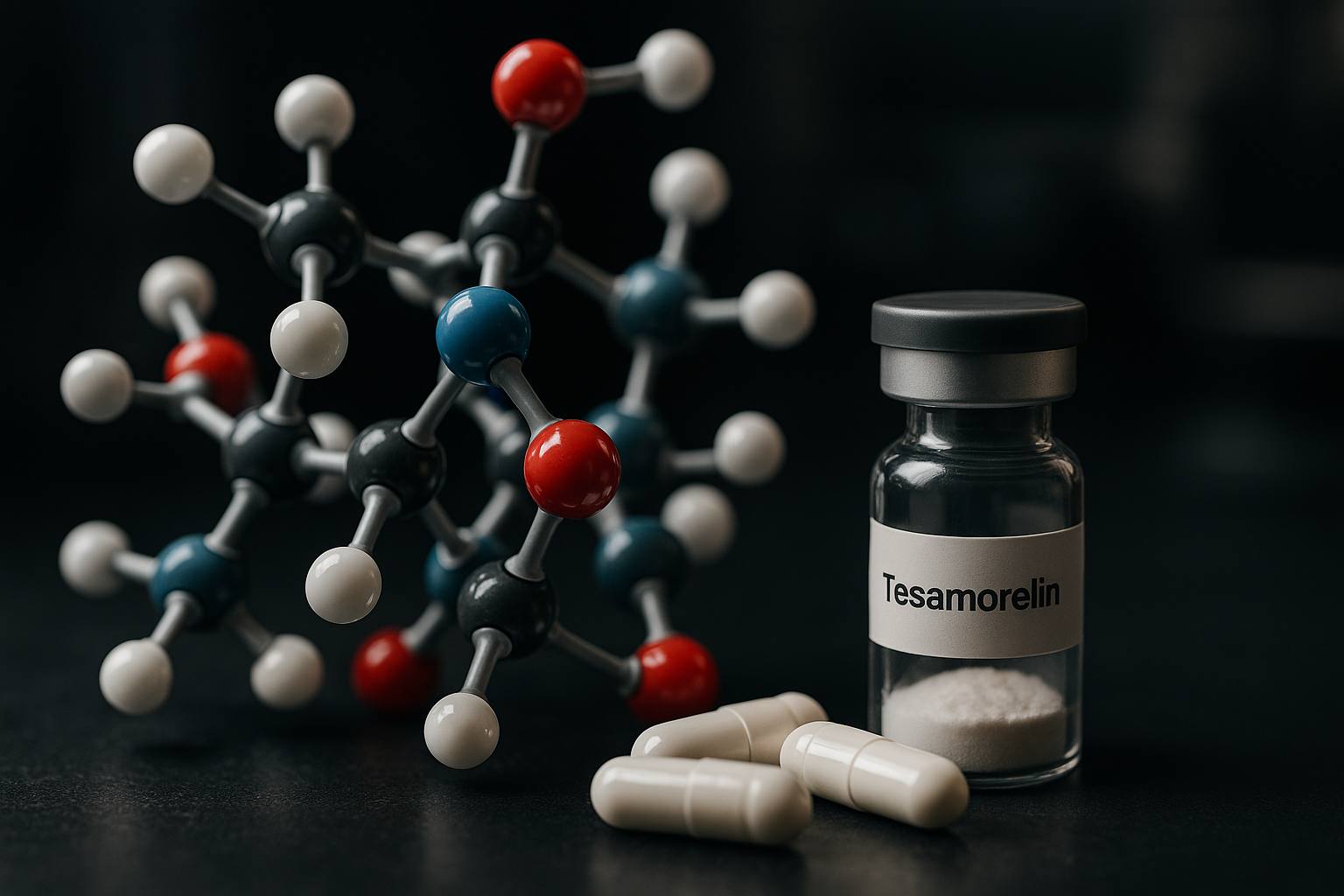
Tesamorelin
Tesamorelin is a synthetic peptide analogue of GHRH designed to stimulate the pulsatile secretion of endogenous growth hormone (GH) and, consequently, increase IGF-1 levels. It has been studied primarily for the reduction of visceral fat in specific clinical conditions (particularly HIV-associated lipodystrophy). It is not a dietary supplement, and its use involves endocrine and metabolic risks that require medical supervision.
GHRH (Growth Hormone–Releasing Hormone) analogue peptide with specific clinical use
Tesamorelin is a synthetic peptide analogue of GHRH designed to stimulate the pulsatile endogenous secretion of growth hormone (GH) and, consequently, increase IGF-1 levels. It has been studied primarily for the reduction of visceral fat in specific clinical conditions (particularly HIV-associated lipodystrophy). It is not a dietary supplement, and its use involves endocrine and metabolic risks that require medical supervision.
Mechanism of action
Agonism of the GHRH receptor (GHRHR) in the anterior pituitary → increased pulsatile secretion of GH → increased hepatic (and peripheral) production of IGF-1. Downstream effects: increased lipolysis and reduced visceral adipose tissue in some contexts; possible effects on glucose metabolism (potential worsening of glucose tolerance in predisposed individuals), fluid retention, and modulation of lipid markers. Because it acts through the GH/IGF-1 axis, it may influence proliferative processes and requires caution in the presence of neoplasms or at-risk conditions.
Supported benefits
- Reduction of visceral fat (VAT) in patients with HIV-associated lipodystrophy, measured by imaging (strong)
- Improvement in some body composition parameters (e.g., waist circumference, waist-to-hip ratio) in selected clinical populations (moderate)
- Increase in IGF-1 levels as a biomarker of GH axis activation (strong)
- Possible changes in lipid profile and cardiometabolic markers in specific contexts (results not consistent across studies) (limited)
Safety & side effects
- Injection site reactions (erythema, pain, itching, induration).
- Peripheral edema/fluid retention, arthralgia, myalgia (effects consistent with increased GH activity).
- Paresthesia or carpal tunnel–like symptoms (reported with GH axis activation in some individuals).
- Headache, nausea (less common).
- Increase in IGF-1 above physiological ranges in some cases (requires clinical monitoring).
- Possible worsening of glucose tolerance or increased blood glucose in predisposed individuals; significant risk in the presence of prediabetes/diabetes.
FAQ
Is it the same thing as growth hormone (GH)?
No. Tesamorelin is a GHRH analogue that stimulates the pituitary to release endogenous GH; GH is the hormone administered directly. Both increase activity of the GH/IGF-1 axis, but with different dynamics and response profiles.
Does it work for fat loss in general?
The strongest evidence concerns the reduction of visceral fat in a specific clinical population (HIV-associated lipodystrophy). There is no robust evidence for generalized use in healthy individuals or for non-selective weight loss.
What are the main metabolic risks?
A significant risk is impaired glucose tolerance (increased blood glucose or worsening glycemic control), in addition to fluid retention and possible neuromuscular symptoms. Increased IGF-1 requires caution in individuals with oncologic risk.
Are the effects permanent?
In several studies, some of the benefits on visceral fat reduction tended to diminish after discontinuation, suggesting that the effect is largely dependent on continued treatment and the clinical context.
Is it safe to buy it online as a “research peptide”?
Purchasing from unregulated channels carries high risks: unverifiable purity and dose, microbiological/endotoxin contamination, peptide degradation, and lack of quality control and pharmacovigilance.
The information provided is for informational and educational purposes only. It does not constitute medical advice. Use must be evaluated and authorized by a qualified healthcare professional.
Mechanism of action
Agonism of the GHRH receptor (GHRHR) on the anterior pituitary → increased pulsatile GH secretion → increased hepatic (and peripheral) production of IGF-1. Downstream: increased lipolysis and reduction of visceral adipose tissue in some contexts; possible effects on glucose metabolism (potential worsening of glucose tolerance in predisposed individuals), fluid retention, and modulation of lipid markers. Because it acts through the GH/IGF-1 axis, it may influence proliferative processes and requires caution in the presence of neoplasms or at-risk conditions.
Scientific benefits
Contraindications
- Active or suspected neoplasms; recent history of tumors: caution due to the potential role of the GH/IGF-1 axis in proliferative processes (specialist evaluation required).
- Pregnancy and breastfeeding (lack of adequate safety data; in regulatory settings often contraindicated or not recommended).
- Known hypersensitivity to the active substance or excipients.
- Conditions in which an increase in GH/IGF-1 is undesirable (to be assessed case by case in an endocrinology setting).
Side effects
- Injection site reactions (erythema, pain, itching, induration).
- Peripheral edema/fluid retention, arthralgia, myalgia (effects consistent with increased GH activity).
- Paresthesia or carpal tunnel-like symptoms (reported with GH axis activation in some individuals).
- Headache, nausea (less common).
- Increase in IGF-1 beyond physiological ranges in some cases (requires clinical monitoring).
- Possible worsening of glucose tolerance or increased blood glucose in predisposed individuals; relevant risk in the presence of prediabetes/diabetes.
Interactions
- Drugs that affect blood glucose (insulin, oral hypoglycemics): possible need for clinical adjustments due to changes in glucose tolerance.
- Therapies that interact with the GH/IGF-1 axis (exogenous GH, other GH secretagogues): potential additive effects and risks.
- Glucocorticoids: may antagonize some anabolic/metabolic effects of GH and influence blood glucose and body composition.
- Antiretroviral therapies: tesamorelin has been studied in HIV patients; clinically relevant interactions depend on the regimen and individual metabolic profile (specialist evaluation required).
Regulatory status
In several jurisdictions it is authorized as a prescription drug for the reduction of visceral fat in patients with HIV-associated lipodystrophy; it is not a dietary supplement. In competitive sports, substances that increase GH/IGF-1 or their analogues/secretagogues may be included on anti-doping prohibition lists (check the updated regulations of the relevant authority).
Supplements and peptides
 Peptides
Bpc-157
BPC-157 is a 15-amino-acid peptide derived from a sequence present in gastric juice (BPC). It is the subject of…
 Peptides
Cjc-1295
CJC-1295 is a peptide designed to stimulate the pulsatile secretion of growth hormone (GH) through activation of the…
 Peptides
Dsip
DSIP (Delta Sleep-Inducing Peptide) is a peptide originally described for its possible ability to modulate sleep…