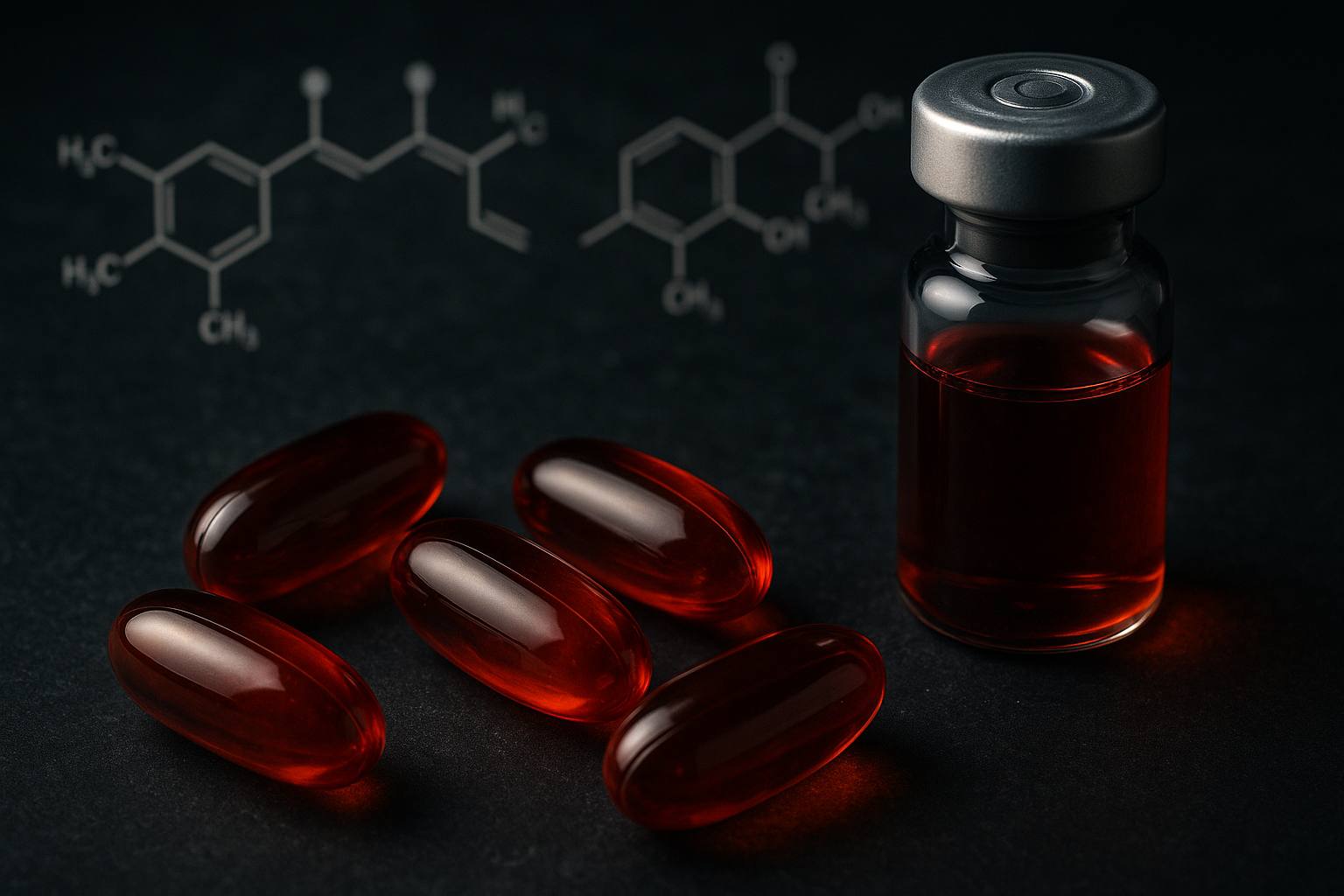
Astaxanthin
Astaxanthin is a carotenoid from the xanthophyll family (a red-orange pigment) produced mainly by microalgae (e.g. Haematococcus pluvialis) and accumulated in some marine organisms. It is known for its high antioxidant capacity in biological systems and its tendency to localize in cell membranes. In the longevity field, it is studied as a modulator of oxidative stress, inflammation, and mitochondrial function, with stronger clinical evidence for skin photoprotection and some cardiometabolic markers, while “hard” outcomes (mortality, cardiovascular events) are not demonstrated.
A fat-soluble carotenoid xanthophyll studied for oxidative stress, inflammation, and photoprotection: potential interest in the “longevity” field
Astaxanthin is a carotenoid in the xanthophyll family (a red-orange pigment) produced mainly by microalgae (e.g. Haematococcus pluvialis) and accumulated in certain marine organisms. It is known for its high antioxidant capacity in biological systems and its tendency to localize in cell membranes. In the longevity field, it is being studied as a modulator of oxidative stress, inflammation, and mitochondrial function, with stronger clinical evidence for skin photoprotection and some cardiometabolic markers, whereas “hard” outcomes (mortality, cardiovascular events) have not been demonstrated.
Mechanism of action
Proposed mechanisms: (1) Membrane antioxidant: scavenging of reactive oxygen species and reduction of lipid peroxidation; possible protection of lipoproteins (e.g. LDL) from oxidation in some contexts. (2) Modulation of redox signaling pathways: activation of Nrf2/ARE with increased endogenous antioxidant enzymes (SOD, catalase, GPx) observed mainly in preclinical studies; in clinical settings, reductions in oxidative markers (e.g. MDA, isoprostanes) are sometimes observed, but not consistently. (3) Anti-inflammatory effects: inhibition of NF-κB and reduction of pro-inflammatory cytokines (e.g. TNF-α, IL-6) in models; in humans, results are variable for CRP and cytokines. (4) Photoprotection: reduction of UV-induced oxidative damage and improvement in skin parameters (elasticity, hydration, wrinkling) in several RCTs. (5) Metabolism and mitochondrial function: preclinical improvements in mitochondrial biogenesis and efficiency; in clinical settings, signals have been observed for insulin sensitivity and lipid profile in subgroups, with inconsistency across studies.
Supported benefits
- Photoprotection and improvement in some skin parameters (elasticity, hydration, wrinkling), along with reduction of markers of cutaneous oxidative stress in controlled studies (moderate)
- Reduction of markers of systemic oxidative stress (e.g. MDA, lipid oxidation) in some populations and conditions (moderate)
- Improvement in some cardiometabolic markers (e.g. triglycerides, HDL, LDL oxidation, insulin sensitivity) in some RCTs, with non-uniform results (limited)
- Support for visual comfort/eye strain and some visual function parameters in specific contexts (e.g. VDT/eye strain), with heterogeneous endpoints (limited)
- Modulation of inflammation (CRP/cytokines) and muscle recovery: signals in small studies, inconclusive (emerging)
- Clinical longevity outcomes (mortality, cardiovascular events, cognitive decline): absence of direct demonstrative evidence (emerging)
Safety & side effects
- Generally well tolerated in studies; possible gastrointestinal disturbances (nausea, dyspepsia, diarrhea) in a minority of individuals
- Possible more intense coloration of stools or skin (rare) with high carotenoid intakes
- Possible mild reduction in blood pressure or blood glucose in some individuals (potentially relevant if on treatment)
FAQ
Is it a proven “anti-aging” compound?
No: there is no direct clinical evidence that astaxanthin increases longevity or reduces mortality/major events. The longevity interest stems from effects on markers (oxidative stress, inflammation, photodamage) and from some results on cardiometabolic parameters, but hard clinical outcomes have not been demonstrated.
What is the difference between natural and synthetic astaxanthin?
The form derived from microalgae is often esterified and accompanied by a natural lipid matrix; the synthetic form may have a different isomer composition. These differences may affect bioavailability and biological activity, but the clinical relevance depends on formulation, dose, and product quality.
Should it be taken with food?
As a fat-soluble compound, absorption tends to improve if taken with a meal containing fats. Many studies administer it with meals.
Can it replace sunscreen?
No. Studies suggest support for the skin’s response to UV stress, but it does not replace sunscreens, protective clothing, and photoprotection strategies.
How long does it take to see effects?
In studies, some endpoints (e.g. oxidative markers or skin parameters) are typically assessed after 4–12 weeks. Response is variable and depends on dose, formulation, and baseline status.
The information provided is for informational and educational purposes only. It does not constitute medical advice. Use must be assessed and authorized by a qualified healthcare professional.
Mechanism of action
Proposed mechanisms: (1) Membrane antioxidant: scavenging reactive oxygen species and reducing lipid peroxidation; possible protection of lipoproteins (e.g. LDL) from oxidation in some contexts. (2) Modulation of redox signaling pathways: activation of Nrf2/ARE with increased endogenous antioxidant enzymes (SOD, catalase, GPx), observed mainly in preclinical studies; clinically, reductions in oxidative markers (e.g. MDA, isoprostanes) are sometimes seen, but not consistently. (3) Anti-inflammatory effects: inhibition of NF-κB and reduction of pro-inflammatory cytokines (e.g. TNF-α, IL-6) in models; in humans, variable results on CRP and cytokines. (4) Photoprotection: reduction of UV-induced oxidative damage and improvement in skin parameters (elasticity, hydration, wrinkles) in several RCTs. (5) Metabolism and mitochondrial function: preclinical improvements in mitochondrial biogenesis and efficiency; clinically, signals on insulin sensitivity and lipid profile in subgroups, with inconsistency across studies.
Scientific benefits
Contraindications
- Pregnancy and breastfeeding: safety data as a supplement are insufficient for recommendations; professional evaluation required
- Allergy to shellfish/krill or to components of the formulation (e.g. fish oil, soy): risk related to the source/vehicle
- Conditions or therapies in which changes in blood pressure or blood glucose are critical: requires clinical supervision
- Conditions requiring restrictions on high-dose antioxidants (e.g. some oncology protocols): specialist evaluation
Side effects
- Generally well tolerated in studies; possible gastrointestinal disturbances (nausea, dyspepsia, diarrhea) in a minority
- Possible more intense coloration of stool or skin (rare) with high carotenoid intake
- Possible mild reduction in blood pressure or blood glucose in some individuals (potentially relevant if on treatment)
Interactions
- Anticoagulants/antiplatelet agents (e.g. warfarin, DOACs, aspirin, clopidogrel): possible theoretical interaction through effects on oxidation/inflammation and potential impact on hemostasis; clinical monitoring if used
- Antihypertensive drugs: possible additive effects on blood pressure in sensitive individuals
- Glucose-lowering drugs/insulin: possible additive effects on blood glucose in some individuals
- Other fat-soluble supplements (vitamins A/E/K, carotenoids): possible competition/accumulation; variable clinical relevance
Regulatory status
Marketed as a dietary supplement in the EU and USA; in the EU it is subject to rules on novel foods/ingredients and authorized limits/claims; in the USA it is often sold as a dietary supplement. Health claims are regulated and do not equate to proof of clinical efficacy on major endpoints.
Supplements and peptides
 Longevity
Apigenin
Apigenin (4′,5,7-trihydroxyflavone) is a flavone found in various food and medicinal plants. In human biology, it is…
 Longevity
Berberine
Berberine is a plant alkaloid found in various plants (e.g. Berberis spp.) and traditionally used in the…
 Longevity
Curcumin
Curcumin is the main curcuminoid of turmeric (Curcuma longa). It is widely studied for anti-inflammatory and…