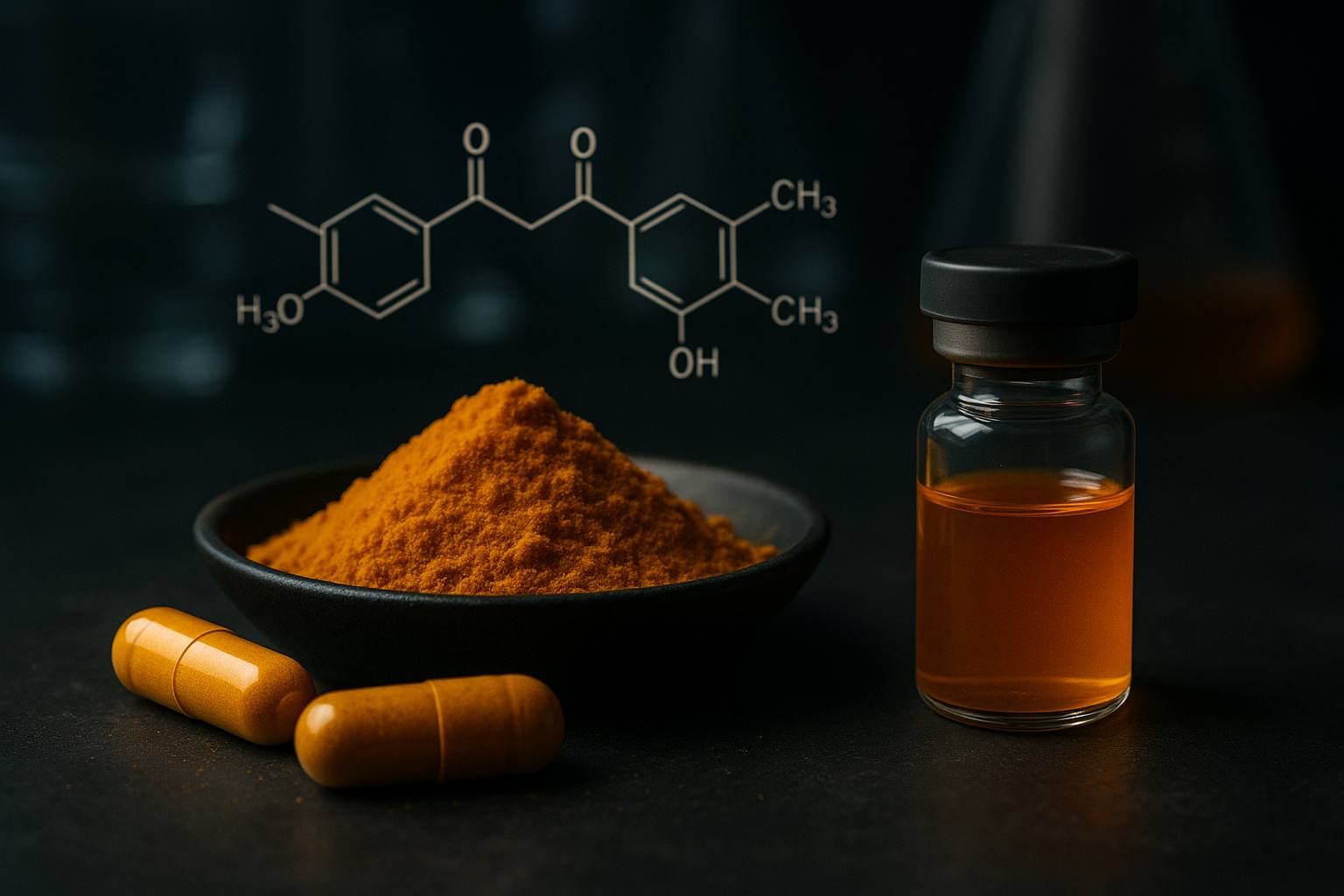
Curcumin
Curcumin is the main curcuminoid of turmeric (Curcuma longa). It is widely studied for anti-inflammatory and antioxidant effects and for modulation of cellular pathways involved in biological aging (e.g. NF-κB, Nrf2). A central limitation is the low oral bioavailability of “standard” curcumin, which is why many studies use enhanced formulations (with piperine, phytosomes, nanoparticles, or complexes). Clinical evidence is more solid for some outcomes (joint pain/inflammation, some metabolic markers) and more heterogeneous for longevity endpoints (e.g. senescence, telomeres, hard outcomes).
A phytocompound from Curcuma longa studied for inflammation, oxidative stress, and cardiometabolic markers from a longevity perspective
Curcumin is the main curcuminoid in turmeric (Curcuma longa). It is widely studied for its anti-inflammatory and antioxidant effects and for the modulation of cellular pathways involved in biological aging (e.g. NF-κB, Nrf2). A central limitation is the low oral bioavailability of “standard” curcumin, which is why many studies use enhanced formulations (with piperine, phytosomes, nanoparticles, or complexes). Clinical evidence is more solid for some outcomes (joint pain/inflammation, some metabolic markers) and more heterogeneous for longevity endpoints (e.g. senescence, telomeres, hard outcomes).
Mechanism of action
Proposed mechanisms (mainly from preclinical studies and partly supported by clinical biomarkers): - Modulation of inflammation: inhibition of NF-κB and reduction in the expression of pro-inflammatory mediators (e.g. TNF-α, IL-6, COX-2, iNOS) in various models. - Activation of antioxidant responses: activation of the Nrf2/ARE pathway with increased defense enzymes (e.g. HO-1, SOD, catalase) and reduction of lipid peroxidation markers in some studies. - Effects on signaling and metabolism: interactions with AMPK, PPAR-γ, and pathways related to insulin sensitivity and lipid metabolism (variable clinical evidence). - Modulation of endothelial function: potential improvement in NO bioavailability and reduction of vascular oxidative stress. - Interaction with proteins and membranes: pleiotropic activity also linked to physicochemical properties (lipophilicity) and to metabolites/conjugates; the physiological relevance of metabolites in humans is still under study. Note: many mechanistic effects are dose-dependent and observed at concentrations that are difficult to achieve with unformulated curcumin.
Supported benefits
- Reduction in pain and improvement in function in osteoarthritis (especially knee) versus placebo; in some studies, efficacy comparable to NSAIDs on certain endpoints, with a different tolerability profile (moderate)
- Improvement in some inflammatory/oxidative markers (e.g. CRP in some contexts; oxidative stress markers), with heterogeneous results across studies and formulations (limited)
- Improvement in cardiometabolic parameters in some subjects (e.g. fasting glucose, HbA1c, triglycerides, LDL), with high variability and possible dependence on baseline status and formulation (limited)
- Support for depressive/anxious symptoms in some trials (often as an adjunct), with methodological heterogeneity and possible bias (emerging)
- Effects on endothelial function and blood pressure in some studies, but not consistent across all endpoints and populations (emerging)
- Longevity endpoints (cellular senescence, telomeres, hard aging outcomes): insufficient direct clinical evidence; biological plausibility is mainly preclinical (emerging)
Safety & side effects
- Gastrointestinal disturbances (nausea, dyspepsia, diarrhea, cramps), more likely at high doses or in sensitive individuals
- Headache or dizziness (less common)
- Rare skin/allergic reactions
- Possible increase in bleeding risk in predisposed individuals or in combination with antiplatelet/anticoagulant drugs (clinical evidence is not unequivocal, but pharmacological plausibility exists)
FAQ
Are curcumin and turmeric the same thing?
No. Turmeric is the spice (rhizome) that contains a mixture of compounds; curcumin is one of the main curcuminoids. Supplements often contain concentrated and standardized extracts, with absorption profiles and doses that are very different from culinary use.
Why is there so much talk about bioavailability?
Unformulated curcumin has limited intestinal absorption and is rapidly metabolized. Many clinical studies use formulations that increase systemic exposure; for this reason, results are not always transferable across different products.
Is it really an “anti-aging” supplement?
The idea comes from its modulation of inflammation and oxidative stress, processes linked to aging. However, direct clinical evidence on aging endpoints (e.g. reduction in events, improvement in validated aging biomarkers) is still limited; the strongest evidence concerns some symptomatic outcomes (e.g. osteoarthritis) and intermediate biomarkers.
Is piperine always a good idea?
Piperine can increase bioavailability, but it can also increase the risk of drug interactions (inhibition of enzymes/transporters). In the case of chronic therapies, the combination requires particular caution.
What are the signs of poor tolerability?
Gastrointestinal disturbances (nausea, diarrhea, burning), worsening of biliary symptoms, and, rarely, signs compatible with liver injury. In such cases, clinical evaluation is indicated.
The information provided is for informational and educational purposes only. It does not constitute medical advice. Use must be evaluated and authorized by a qualified healthcare professional.
Mechanism of action
Proposed mechanisms (mainly from preclinical studies and partly supported by clinical biomarkers): - Modulation of inflammation: inhibition of NF-κB and reduction of the expression of pro-inflammatory mediators (e.g. TNF-α, IL-6, COX-2, iNOS) in various models. - Activation of antioxidant responses: activation of the Nrf2/ARE pathway with increased defense enzymes (e.g. HO-1, SOD, catalase) and reduction of lipid peroxidation markers in some studies. - Effects on signaling and metabolism: interactions with AMPK, PPAR-γ, and pathways linked to insulin sensitivity and lipid metabolism (variable clinical evidence). - Modulation of endothelial function: potential improvement in NO bioavailability and reduction of vascular oxidative stress. - Interaction with proteins and membranes: pleiotropic activity also linked to physicochemical properties (lipophilicity) and to metabolites/conjugates; the physiological relevance of metabolites in humans is still under study. Note: many mechanistic effects are dose-dependent and observed at concentrations that are difficult to achieve with unformulated curcumin.
Scientific benefits
Contraindications
- Pregnancy and breastfeeding: avoid unnecessary use of high-dose extracts due to insufficient safety data (culinary use of the spice is distinct from concentrated supplementation)
- Coagulation disorders or history of bleeding: caution due to potential effect on platelet aggregation
- Biliary disorders (e.g. gallstones, bile duct obstruction): caution because turmeric/curcumin may affect bile secretion in some contexts
- Liver disease or elevated liver enzymes: caution; cases of hepatotoxicity associated with turmeric/curcumin supplements have been reported (rare but clinically relevant)
- Before surgical procedures: caution due to potential effect on bleeding (individual clinical assessment)
Side effects
- Gastrointestinal disturbances (nausea, dyspepsia, diarrhea, cramps), more likely at high doses or in sensitive individuals
- Headache or dizziness (less common)
- Rare skin/allergic reactions
- Possible increased risk of bleeding in predisposed individuals or in combination with antiplatelet/anticoagulant drugs (clinical evidence is not unequivocal, but pharmacological plausibility exists)
Interactions
- Anticoagulants/antiplatelets (e.g. warfarin, DOACs, aspirin, clopidogrel): possible increased bleeding risk; clinical monitoring is necessary if used
- Glucose-lowering drugs: possible enhancement of the effect on blood glucose in some subjects (risk of hypoglycemia in combination, especially with tight control)
- Drugs metabolized by CYP/UGT and transporters (e.g. P-gp): variable risk of interactions; piperine further increases the likelihood of interactions
- Chemotherapy and cancer therapies: potential pharmacodynamic/pharmacokinetic interactions; use only under specialist supervision
- NSAIDs: possible additive gastrointestinal or bleeding effects in predisposed individuals
Regulatory status
In many countries, curcumin/turmeric is marketed as a dietary supplement; it is not approved as a drug for longevity indications. Health claims are regulated and often limited; formulations may fall into different categories depending on local regulations.
Supplements and peptides
 Longevity
Apigenin
Apigenin (4′,5,7-trihydroxyflavone) is a flavone found in various food and medicinal plants. In human biology, it is…
 Longevity
Astaxanthin
Astaxanthin is a carotenoid from the xanthophyll family (a red-orange pigment) produced mainly by microalgae (e.g.…
 Longevity
Berberine
Berberine is a plant alkaloid found in various plants (e.g. Berberis spp.) and traditionally used in the…