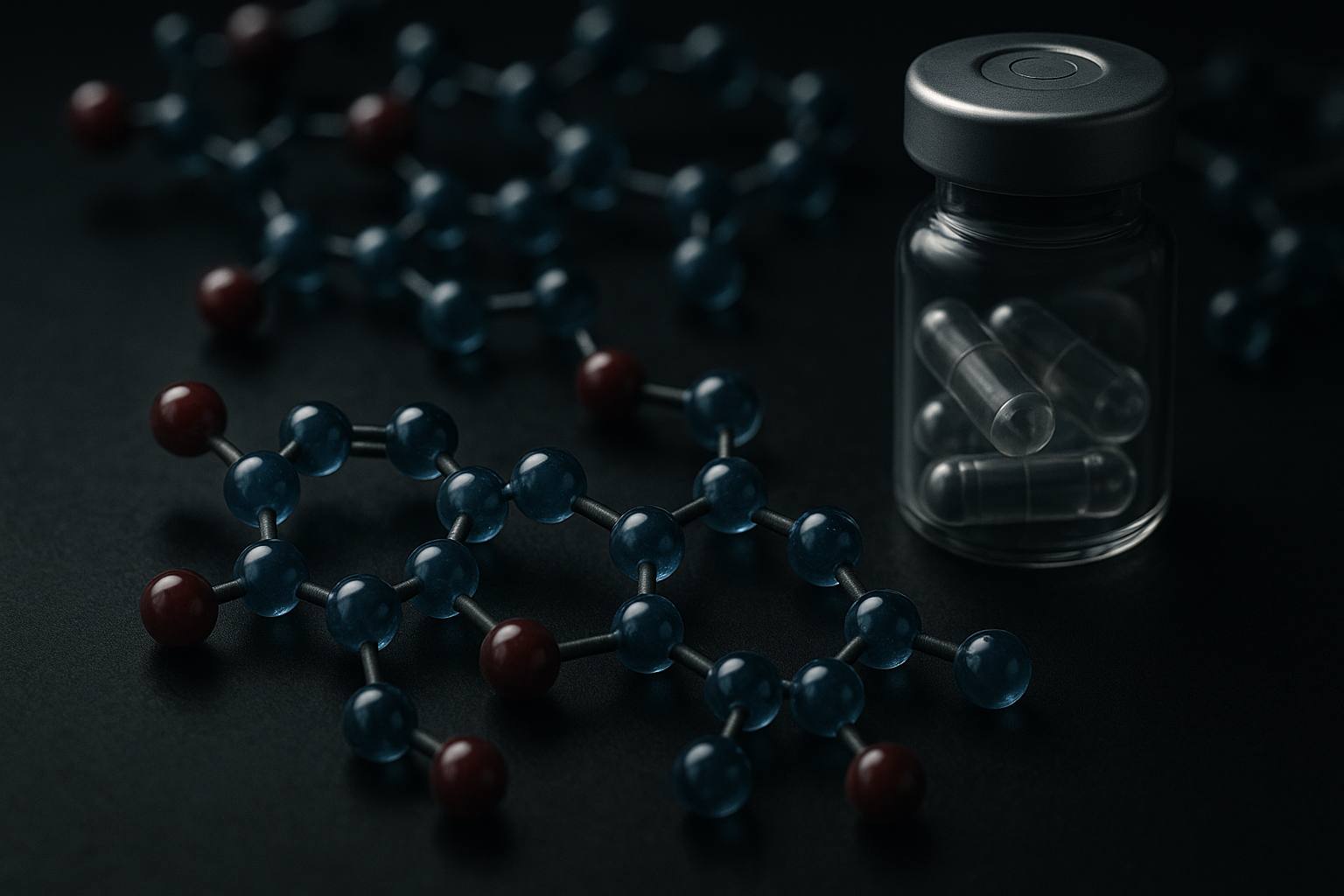
Nad+
NAD+ is a dinucleotide present in all cells, essential for redox reactions (NAD+/NADH) and as a substrate for enzymes that regulate cellular stress, DNA repair, and metabolic homeostasis (e.g. sirtuins, PARP, CD38). With age and under conditions of metabolic/inflammatory stress, tissue levels of NAD+ tend to decline, which is why the NAD+ axis is studied in the field of “longevity”. Direct oral supplementation with NAD+ has limited evidence compared with its precursors (NR, NMN, niacin, nicotinamide).
A central coenzyme for energy metabolism, DNA repair, and cellular signaling; a key target in longevity research
NAD+ is a dinucleotide found in all cells, essential for redox reactions (NAD+/NADH) and as a substrate for enzymes that regulate cellular stress, DNA repair, and metabolic homeostasis (e.g. sirtuins, PARP, CD38). With age and under conditions of metabolic/inflammatory stress, tissue levels of NAD+ tend to decline, which is why the NAD+ axis is studied in the field of longevity. Direct oral supplementation with NAD+ has limited evidence compared with its precursors (NR, NMN, niacin, nicotinamide).
Mechanism of action
1) Redox metabolism: NAD+/NADH regulates electron flow and ATP production. 2) Substrate for sirtuins (SIRT1-7): NAD+-dependent deacetylation/ADP-ribosylation with effects on mitochondrial biogenesis, stress response, and metabolism. 3) Substrate for PARP: poly(ADP-ribosyl)ation in response to DNA damage; high consumption can reduce NAD+ and affect cellular energy. 4) Degradation by CD38: an ectoenzyme that hydrolyzes NAD+ and may increase with age/inflammaging, contributing to NAD+ decline. 5) Synthesis pathways: salvage (from nicotinamide via NAMPT), from NR/NMN, and de novo from tryptophan; the effect of exogenous NAD+ depends on its conversion/transport and on the balance between synthesis and consumption.
Supported benefits
- Increase in systemic biomarkers linked to the NAD pool (e.g. NAD+ in whole blood) with NAD-boosting strategies (stronger evidence for NR/NMN than for oral NAD+) (moderate)
- Improvement in certain metabolic markers or mitochondrial function in specific clinical/experimental contexts (heterogeneous evidence; inconsistent results) (limited)
- Support for DNA repair processes and resilience to cellular stress (mechanistically plausible; clinical translation still incomplete) (emerging)
- Possible impact on inflammation and immunometabolism through modulation of the NAD–sirtuin–CD38 axis (preclinical data are more robust than clinical data) (emerging)
Safety & side effects
- Specific tolerability data for oral NAD+: limited; gastrointestinal disturbances (nausea, abdominal discomfort) have been reported anecdotally or in non-uniform settings
- Headache or nonspecific sensations (evidence is not robust or specific)
- For parenteral routes (not equivalent to use as a supplement): events such as flushing, nausea, chest tightness, or anxiety during infusion have been reported in some settings; frequency and causality depend on the protocol and the setting
FAQ
Are NAD+ and vitamin B3 the same thing?
No. Vitamin B3 includes niacin (nicotinic acid) and nicotinamide, which are precursors used by the body to synthesize NAD+. NAD+ is the final coenzyme used in redox reactions and as an enzymatic substrate.
Why do NAD+ levels decline with age?
Hypotheses include: increased consumption by enzymes such as CD38 and PARP (due to inflammation and DNA damage), reduced efficiency of synthesis pathways (salvage), and metabolic changes that alter turnover of the NAD pool.
Does taking NAD+ orally really increase NAD+ in cells?
It is not guaranteed. NAD+ is a large, polar molecule and may be degraded into precursors in the gastrointestinal tract. Increases in blood and tissue NAD are better documented with precursors (NR/NMN/niacin) than with oral NAD+.
Does increasing NAD+ automatically activate sirtuins?
Not automatically. Sirtuins depend on NAD+, but their activity is also regulated by energy status, cellular signals, substrate availability, and compartmentalization (nucleus, cytosol, mitochondria).
Is NAD+ a proven “anti-aging” intervention?
No. It is a plausible and extensively studied biological target, but there is no definitive proof that supplementation with NAD+ (or its precursors) slows human aging in a clinical sense. The strongest evidence concerns biomarkers and some intermediate outcomes, with variable results.
The information provided is for informational and educational purposes only. It does not constitute medical advice. Use must be evaluated and authorized by a qualified healthcare professional.
Mechanism of action
1) Redox metabolism: NAD+/NADH regulates electron flow and ATP production. 2) Substrate for sirtuins (SIRT1-7): NAD+-dependent deacetylation/ADP-ribosylation with effects on mitochondrial biogenesis, stress response, and metabolism. 3) Substrate for PARP: poly(ADP-ribosyl)ation in response to DNA damage; high consumption can reduce NAD+ and affect cellular energy. 4) Degradation by CD38: ectoenzyme that hydrolyzes NAD+ and may increase with age/inflammaging, contributing to NAD+ decline. 5) Synthesis pathways: salvage (from nicotinamide via NAMPT), from NR/NMN, and de novo from tryptophan; the effect of exogenous NAD+ depends on its conversion/transport and the synthesis-consumption balance.
Scientific benefits
Contraindications
- Pregnancy and breastfeeding: lack of adequate safety data for NAD+ as a supplement
- Pediatric age: safety/efficacy data are lacking
- Active oncological diseases or ongoing treatment: the NAD axis can influence metabolism and DNA repair; the use of NAD-boosting strategies should be evaluated with the clinical team
- Significant liver or kidney diseases: insufficient specific data; caution due to metabolism/elimination and comorbidities
- Heart rhythm disorders or conditions in which acute changes in autonomic tone could be relevant (especially for non-oral routes): caution
Side effects
- Specific tolerability data for oral NAD+: limited; possible gastrointestinal disturbances (nausea, abdominal discomfort) reported anecdotally or in non-uniform contexts
- Headache or nonspecific sensations (evidence not robust and not specific)
- For parenteral routes (not equivalent to use as a supplement): events such as flushing, nausea, chest tightness, or anxiety during infusion have been reported in some contexts; frequency and causality depend on the protocol and setting
Interactions
- Cancer therapies (chemotherapy, radiotherapy, PARP inhibitors): potential theoretical interactions related to DNA repair and NAD availability; specialist evaluation is necessary
- Drugs that affect energy or redox metabolism (e.g. some antidiabetics): specific clinical interactions with NAD+ are not well characterized
- Alcohol: may alter the NADH/NAD+ ratio and liver metabolism; the impact on the effect of exogenous NAD+ is not well defined
Regulatory status
Variable by country and form (supplement vs infusion preparations). In general, therapeutic indications are not authorized for supplements; any products may be subject to controls on purity, contaminants, and labeling accuracy. Intravenous preparations typically fall under different regulatory frameworks and are not comparable to dietary supplementation.
Supplements and peptides
 Longevity
Apigenin
Apigenin (4′,5,7-trihydroxyflavone) is a flavone found in various food and medicinal plants. In human biology, it is…
 Longevity
Astaxanthin
Astaxanthin is a carotenoid from the xanthophyll family (a red-orange pigment) produced mainly by microalgae (e.g.…
 Longevity
Berberine
Berberine is a plant alkaloid found in various plants (e.g. Berberis spp.) and traditionally used in the…