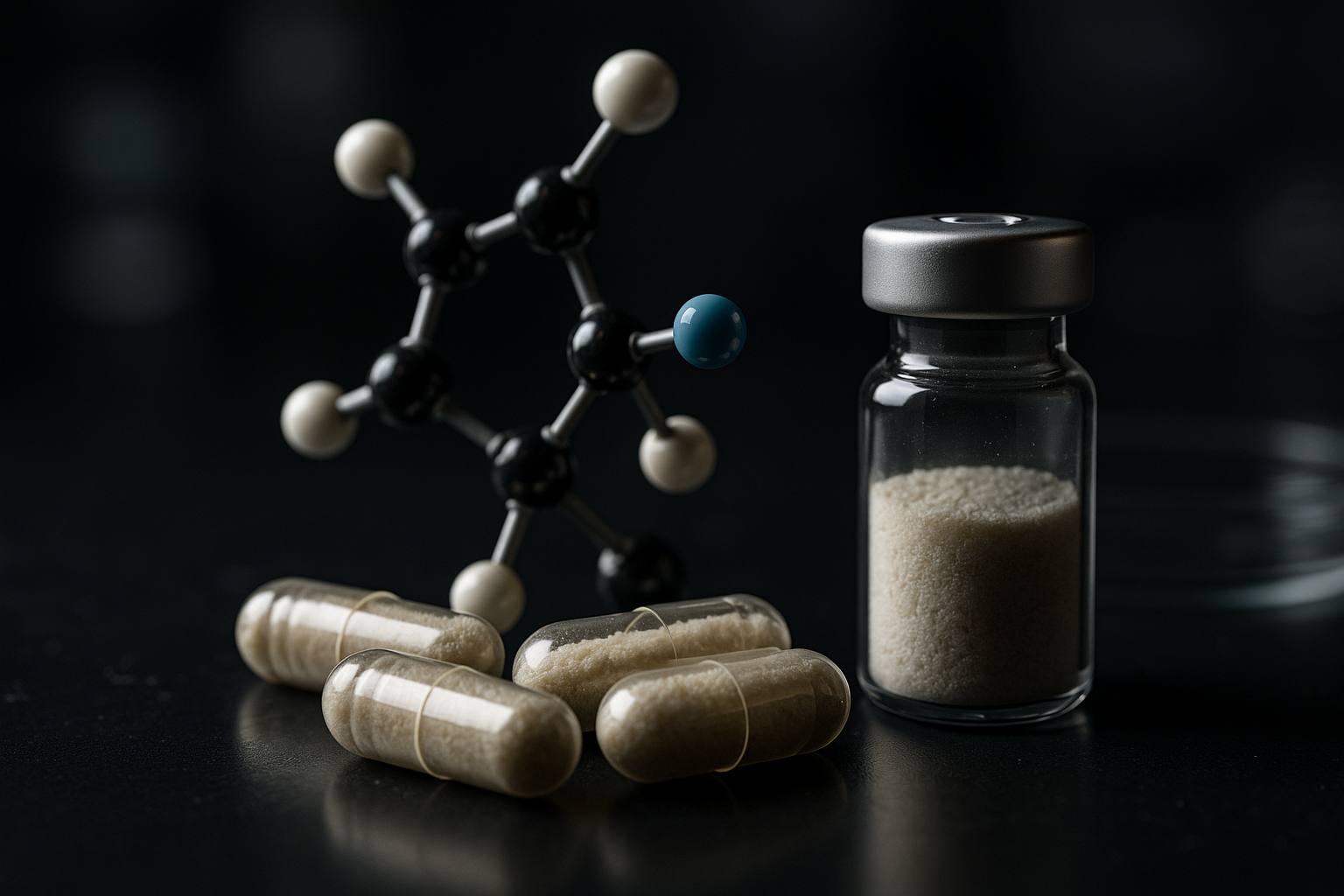
Tryptophan
Tryptophan is an essential amino acid obtained through the diet. In the body, it can be used for protein synthesis or converted into bioactive metabolites, including serotonin and melatonin, and into compounds of the kynurenine pathway (e.g. niacin/NAD+ under specific conditions). Interest in the “Sleep & Recovery” field mainly derives from its role as a precursor of serotonin (involved in regulating mood tone and sleep architecture) and melatonin (a key hormone of the circadian rhythm).
An essential amino acid that is a precursor to serotonin and melatonin, relevant for sleep and recovery
Tryptophan is an essential amino acid obtained through the diet. In the body, it can be used for protein synthesis or converted into bioactive metabolites, including serotonin and melatonin, as well as compounds in the kynurenine pathway (e.g. niacin/NAD+ under specific conditions). Interest in the “Sleep & Recovery” field mainly stems from its role as a precursor to serotonin (involved in the regulation of mood and sleep architecture) and melatonin (a key hormone of the circadian rhythm).
Mechanism of action
1) Transport to the brain: tryptophan crosses the blood-brain barrier via LAT1, competing with other LNAAs; therefore, not only the absolute dose matters, but also the dietary context (tryptophan/LNAA ratio). 2) Serotonin synthesis: in the CNS, tryptophan is converted into 5-hydroxytryptophan (5-HTP) by the enzyme tryptophan hydroxylase (the rate-limiting step), then into serotonin (5-HT). 3) Melatonin synthesis: serotonin can be converted into melatonin in the pineal gland (N-acetyltransferase and hydroxyindole-O-methyltransferase), under circadian regulation. 4) Kynurenine pathway: a significant portion of tryptophan is metabolized along the kynurenine pathway (IDO/TDO), modulated by inflammation, stress, and immune status; some metabolites may influence neurophysiology and fatigue perception. 5) Functional effects: potential modulation of drowsiness, sleep latency, and certain aspects of mood/stress, with interindividual variability.
Supported benefits
- Reduced sleep onset latency and/or subjective improvement in sleep in some studies, especially with gram-range doses and in subjects with sleep difficulties (moderate)
- Possible increase in drowsiness and changes in some sleep architecture parameters (e.g. sleep continuity) in experimental settings (limited)
- Indirect support for serotonin/melatonin synthesis (strong biological rationale), but with variable clinical outcomes depending on context (diet, LNAA competition, stress/inflammation) (moderate)
Safety & side effects
- Drowsiness, sedation, reduced alertness (relevant for driving/operating machinery)
- Nausea, gastrointestinal disturbances (e.g. cramps, diarrhea), headache
- Dizziness
- Vivid dreams in some individuals
- Rarely: hypersensitivity reactions (uncommon)
FAQ
Are tryptophan and 5-HTP the same thing?
No. Tryptophan is the dietary precursor; 5-HTP is an intermediate closer to serotonin. 5-HTP bypasses the rate-limiting step (tryptophan hydroxylase) and may have a different effects/interactions profile. Both can interact with serotonergic medications.
Why does the effect on sleep vary between people?
It depends on multiple factors: the tryptophan/LNAA ratio in the diet, absorption and albumin binding, stress/inflammation (kynurenine pathway), individual sensitivity to serotonergic changes, and the presence of primary vs. secondary insomnia.
Is it true that turkey “makes you sleepy” because of tryptophan?
Turkey contains tryptophan, but also other competing amino acids. Post-meal drowsiness is often more related to the quantity of food, meal composition (carbohydrates/fats), circadian rhythm, and behavioral factors than to tryptophan alone.
Can tryptophan improve mood?
As a precursor to serotonin, there is a biological rationale; however, clinical effects on mood are heterogeneous and do not replace diagnostic and therapeutic approaches for mood disorders.
Can it be taken every day?
Studies include both acute protocols and protocols lasting several weeks. The safety and appropriateness of continuous use depend on dose, concomitant medications, clinical conditions, and individual tolerability; professional evaluation is advisable.
The information provided is for informational and educational purposes only. It does not constitute medical advice. Use should be evaluated and authorized by a qualified healthcare professional.
Mechanism of action
1) Transport to the brain: tryptophan crosses the blood-brain barrier via LAT1, competing with other LNAAs; therefore, not only the absolute dose matters, but also the dietary context (tryptophan/LNAA ratio). 2) Serotonin synthesis: in the CNS, tryptophan is converted into 5-hydroxytryptophan (5-HTP) by the enzyme tryptophan hydroxylase (rate-limiting step), then into serotonin (5-HT). 3) Melatonin synthesis: serotonin can be converted into melatonin in the pineal gland (N-acetyltransferase and hydroxyindole-O-methyltransferase), with circadian regulation. 4) Kynurenine pathway: a significant portion of tryptophan is metabolized along the kynurenine pathway (IDO/TDO), modulated by inflammation, stress, and immune status; some metabolites may influence neurophysiology and perception of fatigue. 5) Functional effects: potential modulation of drowsiness, sleep latency, and some aspects of mood/stress, with interindividual variability.
Scientific benefits
Contraindications
- Pregnancy and breastfeeding: insufficient safety data for unnecessary supplemental use
- Bipolar disorder or history of mania/hypomania: potential risk of mood destabilization with substances that affect serotonin (specialist evaluation required)
- Significant liver or kidney disease: metabolism and elimination may be altered (clinical evaluation required)
- History of eosinophilia-myalgia syndrome (EMS) or past exposure to contaminated batches: high caution
Side effects
- Drowsiness, sedation, reduced alertness (relevant for driving/operating machinery)
- Nausea, gastrointestinal disturbances (e.g. cramps, diarrhea), headache
- Dizziness
- Vivid dreams in some individuals
- Rarely: hypersensitivity reactions (uncommon)
Interactions
- Serotonergic drugs (SSRIs, SNRIs, MAOIs, tricyclics, triptans, linezolid, lithium): increased risk of serotonin syndrome (potentially serious).
- Serotonergic herbs/supplements (e.g. St. John's wort, 5-HTP): possible additive serotonergic effects.
- Sedatives/hypnotics and alcohol: possible increase in sedation and psychomotor impairment.
- Carbidopa (used in Parkinson's): interactions with precursor amino acids have been reported; medical supervision is required.
Regulatory status
In many countries it is sold as a dietary supplement; permitted health claims and dose/labeling limits depend on local regulations. In the sports context, it is not typically a prohibited substance, but cross-contamination of supplements is a general risk to consider.
Supplements and peptides
 Sleep & Recovery
5-HTP (5-hydroxytryptophan)
5-HTP is a metabolic intermediate between L-tryptophan and serotonin (5-HT). Because it crosses the blood-brain barrier…
 Sleep & Recovery
Ashwagandha ksm-66
KSM-66 is a Withania somnifera root extract standardized in withanolides, studied primarily for modulation of the…
 Sleep & Recovery
Ashwagandha sensoril
Sensoril® is a patented extract of Withania somnifera (ashwagandha), typically standardized to withanolides and…